Showing posts with label Visual Motor Skills. Show all posts

Tuesday, May 19, 2026

Under the Sea Fine Motor Activity!

This is an awesome activity because it’s simple, inexpensive and fun for any toddler or young child. It is a great way for a child to work on the following skills: fine motor, finger isolation, pincer grasp, and visual-motor skills. It is also a good way to address following directions, paying attention, and naming colors. 

Materials Needed:

Simply draw and cut out your child’s favorite sea creature, draw dots that are the same size at the stickers, and it’s time to peel and place the dots! Tip: You can challenge your child and work on color identification by instructing them to find and place a certain color dot!


Saturday, January 25, 2025

Entertaining DIY Activity for Infants & Toddlers

x


This DIY actvity is an inexpensive way to entertain your infant or toddler while they work on their visual motor and bilateral skills! It's a nice way to work on grasping, placing, and releasing in a controlled manner. All you need are popsicle sticks and a clean to-go coffee cup and lid.

'
 
After a bit of practice, this little one progressed to holding the cup with one hand and placing the popsicle sticks with the other hand. Well done!


Sunday, January 16, 2022

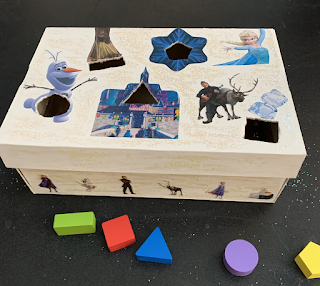
Make your own DIY shape sorter toy!

In this post, I am going to explain how to make a DIY shape sorter toy! You probably have the necessary materials right in your home! A shape sorter is a fun activity that helps to improve visual perception skills, spatial awareness, eye-hand coordination, and fine motor skills. When a child plays with a shape sorter, they engage their problem-solving skills and learn about colors, and shapes.


Needed:
- Shoe Box Scissors
- Pencil, crayons, or marker
- Colorful 3-D shapes or wooden blocks
- Contact paper- Stickers

Directions:
Cover the box and lid with contact paper. Secure the edges of the contact paper in place with tape if needed. Place each shape on the lid of the box, and trace the outline of each shape. Use the scissors or a craft knife to cut out the shapes. Press each shape through corresponding hole to make sure they all fit. Have the child help decorate the box using crayons, markers, and/or stickers, and it’s time to play! Have fun!!!
 

This project was completed by a Master of Occupational Therapy student at The University of Tennessee Health Science Center and posted with permission.

Tuesday, April 16, 2019

Free Spring Worksheets!

Hi friends!  Here are some free spring-themed worksheets that are good for a child's visual motor and visual perceptual skills. Completing these worksheets is a fun and engaging way for a child to improve motor skills that are so important for everyday tasks. How?  Coloring promotes bilateral upper extremity skills, or the use of both hands together in a coordinated way.  For example, when the child stabilizes the paper with one hand while coloring, drawing, or writing with the other hand, she is utilizing bilateral skills, and bilateral coordination is necessary for tasks such as handwriting, cutting, buttoning, and zipping. 

I hope your child will enjoy these free spring-themed worksheets!


Wednesday, January 23, 2019

Free Valentine's Day Worksheets!


I love Valentines Day!  Here are 5 free Valentine's Day worksheets that address visual perceptual skills and fine motor skills.  Just click on the worksheet to go to a PDF copy. Enjoy, and have a happy Valentine's Day!

http://drannezachry.com/wp-content/uploads/2019/01/VdayWorksheet_Decorate.pdf


http://drannezachry.com/wp-content/uploads/2019/01/VdayWorksheets-07.pdf

http://drannezachry.com/wp-content/uploads/2019/01/VDay_Maze.pdf

http://drannezachry.com/wp-content/uploads/2019/01/VdayWorksheet_Word-Find.pdf


Wednesday, June 27, 2018

BOOK GIVE-A-WAY: The Centipede Who Couldn’t Tie His Shoes

We have a winner!  Congratulations to Sue R! 

Attention all teachers and therapists!  Have you ever known a child who struggled with learning to tie her shoes?  This is an important task that seems basic, but it is actually very complex, and for a child with special needs, shoe-tying can be overwhelming. Fortunately, Karen Dobyns, OTD, OTR/L has written a very special book on shoe-tying that every professional who works with young children needs to have on their bookshelf! 

The Centipede Who Couldn’t Tie His Shoes” tells the story of Ben, a kind and sensitive second grader with visual challenges who is having difficulty learning how to tie his shoes. Obviously, this is a big problem, because Ben is a centipede with 100 feet!  What to do?  I’m not going to tell you what happens, because I want you to purchase the book, but rest assured the problem is solved when a school occupational therapist enters the picture.

This lovely book includes sections that explain shoe-tying, and it will help young children without special needs see the perspective of a child who might need special services and support.  To top it off, the delightful illustrations bring Ben’s world to life!
Click HERE to purchase the book on Amazon. Please click HERE to like my Facebook page.

Karen Dobyns, OTD, OTR/L, is a pediatric occupational therapist who has spent her career working with children with special needs in schools, clinics, and homes.  She has a clinical doctorate and master’s in occupational therapy.  Special note: Karen is a graduate of the University of Tennessee Health Science Center Occupational Therapy, which is where I teach! Everyone at UTHSC is extremely proud of her accomplishments!

Sunday, August 28, 2016

Make Your Own Magnificent Maze

Do you want to make a Magnificent Maze?  This is a great activity for bilateral coordination, visual motor skills!

Draw the outline of a maze on a firm piece of foam board or cardboard. Make it simple or more difficult, based on what you feel will be a "just right challenge" for the child.  Leave enough space in the pathways for the ball to travel through.  Lay the straws out on top of the maze lines and cut them to the appropriate length (see photo above).  Use colorful duct tape to hold the straws in place.  Now instruct the child to navigate the ball through the maze.  Have fun!

The project above was completed by one of our Master's of Occupational Therapy students at 
The University of Tennessee Health Science Center and posted with permission.

Thursday, April 7, 2016

Therapeutic DIY Game: Take Me Out to the Ball Game!

Do you work with a child who loves baseball?  Here is an easy, DIY activity that will be motivating for him!  This activity addresses eye hand coordination, balance, and gross motor skills.  Add light weights to the child’s wrist to work on strengthening!

Materials needed: Trifold display board, scissors, markers, yarn, game pieces, Velcro, and plastic baseballs

How to Make the game:

1.     On the center section of display board, cut out 3 circles of different sizes.  Each circle needs to be assigned a number of points (if the child throws the ball into that circle).  Make sure all circles are large enough for the ball to fit through.

2.     On the left side of the display board, draw a baseball diamond with all 4 bases.  In between each base, draw lines in proportionate segments.  Each of the segments represents a score of 5 points.  This will form your score board.  Place Velcro pieces on each segment to later attach a game piece.

3.     On the right section of the display board, attach game pieces to the board by using Velcro.  The game pieces can be made out of felt or poster board.

4.     Use markers to design the trifold board to be baseball themed.

5.     Punch a hole in the board large enough to slide a piece of yarn through.  This is where you will store the yarn that the client stands behind while playing the game.

*Optional

      1. Make an additional score board on a piece of foam so that the child can play the game with other individuals.

      2. Attach yarn to the foam to form a handle.  The child can carry the score board over their shoulder during the game instead of using the score board located on the trifold.

 How to play the game:

1.     Set the game board on a flat surface appropriate to the child’s height.  The bottom of the board should line up to their waistline.

2.     Have the child stand behind a line (yarn) on the floor.

3.     Next, the child should attempt to throw a ball into one of the holes in the board.

4.     If the child scores, the therapist or child can move the game piece on the scoreboard to the correct Velcro strip- depending on the point value of the hole that the ball went through.

5.     Continue the game, alternating between all players, until someone reaches home plate.
The project above was completed by one of our Master's of Occupational Therapy students at 
The University of Tennessee Health Science Center and posted with permission.

Sunday, June 14, 2015

Occupational Therapy Activities: Design Copy Worksheet


        Welcome to Pediatric Occupational Therapy Tips! My blog has tons of occupational therapy activities for children! Visual perception is a skill that many young children struggle with. Visual perceptual activities are a great way for children to work on these skills while having fun.
          Research reveals that there is a relationship between written language and the ability to draw or copy designs. If a child has problems with visual perceptual skills, fine motor skills, or visual motor integration, design copy activities can be an effective therapeutic activity.
           Here is an of examples of “do it yourself” design copy worksheet that I frequently use with children who have visual motor and visual perception challenges. The activity can be graded (made more challenging) by increasing the number of dots.  Kids typically enjoy attempting to copy the designs, and this is a fun way to work on directionality,  motor planning, attention to task, and visual motor skills.

Dear Readers, If you have found my blog to be helpful, please follow my blog (on the right of this page) and click here and "like" my facebook page... 
Thanks :) 

Saturday, January 17, 2015

Motor Skill and Brain-Boosting Developmental Toys for Baby's First Year

Parents often ask me to recommend developmental toys, but I usually recommend simple household objects for play. For example, when children play with empty boxes or pots and pans, they use their imaginations which is wonderful for fostering creativity.  However, new toys at Christmas or on birthdays are always a treat! Here are several of my favorites:

Sassy Ring O' Links Rattle Developmental Toy


These rings are brightly colored which is good for visual stimulation. Babies enjoy shaking and manipulating them, which is wonderful for fine motor skills. I especially like the different textures on the rings!

Fisher-Price Brilliant Basics Rock-a-Stack

This toy is also colorful and the stacking task is nice for developing eye-hand coordination. While your baby is playing with the rings, you can teach him about the concepts of big and small.

Here's another toy that's good for motor skills. Babies love to take and out of containers and put them back in, so this toy typically keeps a child occupied while also addressing eye-hand coordination.  During play, teach him the names and colors of the shapes.

The First Years Stacking Up Cups

Here's another basic stacking/nesting toy that I really love. These are super neat because they have numbers on the bottoms, so your baby can learn about counting as well as color and number recognition, and of course, stacking and placing the toys is wonderful for manipulative skills.


Monday, December 29, 2014

Let's Go Fishing Game!

This is a fun therapeutic activity that is simple and inexpensive to make.

You will need:

Colorful sponges
Paper clips
Magnet
Sharpie
Scissors
Empty paper towel roll
String or yarn
Tape
-Cut the sponges into various "ocean" shapes and use a Sharpie marker to add eyes, etc. The child may even want to decorate the sponges using sequins, stickers, etc.

-Place a clothespin through each sponge making a "hook"

-Tape a piece of string to one end of the paper towel roll and tie the magnet on the end of the string.

Instruct the child to use the fishing pole to "go fishing" for the various sponges. This activity is great for working on matching and identifying colors and shapes. It's also wonderful for eye-hand coordination. Add a light weight to the child's wrist to work on strengthening.  You can also address multiple step directions. For example, instruct the child to 1) put the fish on the green square 2) the octopus on the yellow square, 3) and the star on the blue square. There are lots of options for adapting this activity!  Have fun :)

Dear Readers, If you have found my blog to be helpful, please "like" my Facebook page and follow my blog...Thanks :) 

Friday, November 28, 2014

Occupational Therapy Activities for Visual Perceptual Skills and Following Directions


Occupational therapy activities are fun activities that help children with visual perceptual skills, motor skills, sensory processing, and many more areas of need!   Here is a simple and wonderful activity for working on a variety of skills, including visual perception, motor planning skills, and following directions.

Materials needed:

1 foam board or thin piece of plywood
Chalk Paint
Colored Chalk
Scrap pieces of felt
Popsicle sticks
Matchbox car

Paint the board and let it dry for 3 days. Use the colored chalk to draw any arrangements of roads. Decorate the board with signs and other fun ideas using felt pieces and Popsicle sticks.

This activity addresses multiple skills. Have the student maneuver the car to a destination that you give either verbally or written. You can also give specific directions (verbally or written), For example, "take the first left, then the second right, go straight at the stop sign and park beside the tree." The board can be made more elaborate to include tunnels (made from 1/2 of of a toilet paper roll), houses, and bridges. As you see, the activity can be graded up or down, based on the child's abilities!

Dear Readers, If you have found my blog to be helpful, please "like" my Facebook page and follow my blog...Thanks :) 


The project above was completed by one of our Master's of Occupational Therapy students at The University of Tennessee Health Science Center and posted with permission.

Sunday, July 13, 2014

Motor Planning Balloon Games: Have Some Fun!!!


Suspend a balloon from the ceiling or a doorframe using a long piece of string. Have your child hit the ball while having her say or sing the A-B-C’s or while counting. For example, A- hit the balloon, B- hit the balloon, etc. You can also make this more difficult by removing the string, and having her keep the balloon in the air as long a possible by hitting it while saying the A-B-C’s. Can she get all the way through the alphabet and keep the balloon in the air? This is also a fun activity for practicing spelling words!

Dear Readers, If you have found my blog to be helpful, please "like" my Facebook page and follow my blog...Thanks :) 


Monday, October 14, 2013

Weavable Toys Challenge Visual-Motor and Visual-Perceptual Skills


Designed by Barbara Smith, occupational therapist, these weavable toys are fun and a great activity to work on dexterity, bilateral skills, and eye hand coordination! Your child can tap into his creativity by designing his own pattern, or you can make a pattern for him to imitate. This improves concentration and is wonderful for working on sequencing and visual perceptual skills. The set comes in a variety of shapes and colors, which makes them great for matching, color, shape and size recognition and naming. Your child can also improve her ability to follow directions and understand positional concepts if you give her instructions such as, “lace the square first, the circle second, and the heart third.” Let the fun begin!


Monday, September 9, 2013

Therapy on a Shoestring Budget- Make a Homemade Marble Maze

This post is the first in a series of posts about "Therapy on a Shoestring Budget." I know first-hand how expensive therapy supplies can be,  so I've decided to share some fun, inexpensive, therapeutic ideas. I hope you find these posts helpful!
Hi Parents and Therapists!
Here is a fun handmade activity that is relatively easy to make. Supplies needed:

Colorful plastic straws
A sturdy piece of cardboard or foam board
Scotch tap
A brightly colored marble
A large Popsicle stick

Draw the outline of a maze on the foam board. Make it simple or complex, based on what you feel will be a "just right challenge" for the child.  Make sure that you leave enough space in the pathways for the marble to travel through. Lay the straws out on top of the maze lines and cut them to the appropriate length (see photo above).  Use Scotch tape to hold the straws in place (I tried a hot-glue gun, but the tape worked better). Use tape to secure the large Popsicle stick on the back side of the foam board to make the handle.  In one corner, write "start" and draw a star or smiley face. At the end of the maze write "end or finish" and draw something like a stop sign or finish line.

Now, it's time to play with the maze! This activity provides a fun way to work on grasping, visual tracking, eye hand coordination, and graded pronation and supination. If the child needs to work on upper extremity strengthening, just add a light weight to his wrist.  Have fun!


Dear Readers, If you have found my blog to be helpful, please "like" my Facebook page and follow my blog...I'm trying to get my book published and this would be a great help! Thanks :) 

Saturday, July 27, 2013

Fun Motor Planning and Auditory Processing Activities


Here are some fun games that can be enjoyed indoors or outside. If you prefer outdoors, use sidewalk chalk instead of tape.
Bean Bag Toss- Tape different shapes on the floor and give the child several beanbags. Tell him to toss a bag on the square first, then on the circle, then on the triangle. If you have various colors, say “toss the blue bag inside the blue circle, or toss the blue beanbag inside the red shape." You can then ask him, "which shape is red?" so that he has an opportunity to name it. If you want to keep score, give higher points for the smaller shapes.

A slightly more challenging activity is to have the child bounce a ball inside each of the shapes then catch it. Once again, call out the instructions: "Bounce the ball on the triangle, then the square, then the rectangle. You can call out one instruction at a time, or make it more challenging by giving multiple step instructions. You want the child to be challenged, but not frustrated. Have fun!


Dear Readers, If you have found my blog to be helpful, please "like" my Facebook page and follow my blog...I'm trying to get my book published and this would be a great help! Thanks :) 

Thursday, May 9, 2013

Keeping Cursive Alive


PediaStaff recently contacted me and asked me to write an opinion piece on cursive handwriting in response to this article in the New York Times. I was happy to do so! 

Keeping Cursive Alive
When my 12-year-old daughter left for summer camp, I slipped some stationary into her suitcase and asked her to write me while she was away.  I checked the mailbox regularly, looking forward to a letter, but to my dismay, she never wrote. Once she was home, I asked her why she never wrote.

“It takes too long to write a letter. If I’d had my laptop, I could have just typed you a letter, but I don’t like to write,” she declared.

I was surprised and a little sad. I have wonderful childhood memories of corresponding with my pen pal, Lori, who lived in Hawaii, and writing letters to my parents when I was at summer camp was a fun experience. I always added a P.S. at the end of every note, and I loved sealing the envelope and adding a stamp. Are those days really gone?

Unfortunately, they may be. The new Common Core Standards require legible handwriting in Kindergarten and grade 1, but they do not include cursive handwriting. However, the standards do state that by the end of Fourth Grade, students must demonstrate the keyboarding skills necessary to complete a one-page writing assignment.

As an OT, I am very much “pro-cursive.” Why? Writing in cursive has a number of benefits.

·      Writing in cursive develops visual motor and manipulative skills, which are important for daily living skills, recreation, and work.

·      Research suggests that students who write in cursive efficiently have better academic skills, including reading comprehension.

·      One must be able to read cursive handwriting in order to read historical documents written in cursive.

·      Research reveals that students who write in cursive receive better grades than those who print.

·      Requiring keyboarding at young ages can be a detriment because if the child’s hands are too small for the keyboard, they will develop a habit of “hunting and pecking,” which can be difficult to break.

·      Too much time in front of a computer screen can lead to eyestrain, discomfort, and headaches.

·      A cursive signature is important for preventing forgery and necessary when signing legal documents.

Important Points

·      Regular practice and reinforcement are necessary when learning print, write in cursive, AND keyboard correctly and efficiently.

·      Just like cursive handwriting, keyboarding is an important skill. It allows for ease in editing, guarantees legibility, and is an ideal tool for children who have dysgraphia. Students should be skilled with handwriting skills AND keyboarding skills.

It is my hope that school systems continue to include cursive instruction in their curriculum, despite the fact that cursive is not included in the Common Core Standards.

To hear more thoughts on cursive in this era of technology, check out PediaStaff's blog post with links to other articles written by occupational therapists in response to the NYT Article! 
 
 Photo Credit: Microsoft Office


Sunday, January 20, 2013

Sequin Art Projects are Great for Fine Motor Skills

I love these little sequin art kits. They are great for fine motor skills and kids love them! I found some at a local craft store, but they are also available on Amazon (click here).  Kids gets plenty of opportunities to practice a pincer grasp when picking up and peeling the sequins/stickers. Placing and aligning the sequins in the little circles is also great for eye hand coordination and visual perception. In the video below, this student is doing a great job with hers!

Dear Readers, If you have found my blog to be helpful, please "like" my Facebook page and follow my blog...I'm trying to get my book published and this would be a great help! Thanks :) 

Tuesday, July 19, 2011

Ataxia

An individual with ataxia has rapid muscle tone fluctuation which can vary from low to normal tone. Because ataxia is a movement disorder, it can have a disorganizing effect on day-to-day functioning. The fluctuation of muscle tone is most observable in the arms and hands, but it also occurs in the trunk and oculomotor (visual-motor) system. With ataxia, stretch reflexes and balance reactions are frequently exaggerated leading to problems with balance and coordination.

Here are some suggestions for working with students who have ataxia:

-Work close to the body or trunk with consistent placement of the hands.
-Provide firm pressure- pull the rib cage down with heavy, consistent control.
-Work to develop control of a few midrange positions and postures.
-Include exercises to strengthen the triceps.
-Always work rhythmically and predictably.
-Provide a source of support for stability, such a something to hold onto while working.
-If the child is mobile, provide support and guidance while walking and have the child visually search for objects so he will not stabilize using the visual (occulomotor) system for compensation, which can be a safety hazard.
-Always tell the child when you are changing activities or placement of materials.
-Place objects in the same spot repeatedly for consistency.
-Work on dycem or other non-skid material for stability.
-Provide heavy toys to play with or use weighted wrist cuffs (consult a therapist to see which weight is most appropriate for each individual child)
-Use firm theraputty for hand exercise.
-Be aware of potential fatigue issues and provide frequent breaks if necessary.
-Always consult a physical or occupational therapist if you have specific questions when working with a student with ataxia.

For more information on ataxia, consult the following website: http://www.ataxia.org/learn/ataxia-diagnosis.aspx 

Photo Credit: Ambro @ freedigitalphotos.net

Dear Readers, If you have found my blog to be helpful, please "like" my Facebook page and follow my blog...I'm trying to get my book published and this would be a great help! Thanks :) 

Sunday, March 20, 2011

Medium Motor Activities


When teaching a child to write, you should begin with the large motor activities suggested on the March 19th post. You then move on to medium motor activities. Here are some suggestions for medium motor activities:
  • Writing in shaving cream that is on a paper plate or cookie sheet.  
  • Have the child form the letters using Elmer’s glue on a piece of card stock then sprinkle the glue with colored sugar or colored sand. Once dry, these make nice tactile cards for tracing the letters with a fingertip. Have the child trace the letters with her eyes closed so that she can “feel” the formation.  
  • Trace and write large letters on a sheet protector using a dry erase maker  
  • Form letters out of play dough or putty  
  • Form letters out of wikki stix  
  • Fill a large ziplock freezer bag with cheap hair gel and glitter. Smooth it out and have the child trace and write on this using a fingertip.   
 
All of these activities will help children develop automatic motor memories for each letter formation.


Modified from information by Jan McCleskey, MA, OTR, The Handwriting Clinic, Plano,Texas