Showing posts with label Autism. Show all posts

Tuesday, April 28, 2020

A Visual Schedule to Help with Challenging Morning Routines


Dealing with problem behaviors in the home setting can be challenging, especially with children who have a diagnosis of Autism Spectrum Disorder. For these children, maintaining focus in order to complete morning tasks independently can be quite difficult, especially when everyone else in the family is rushing around getting ready for the day. 

This is a situation when a visual schedule can be helpful. A visual schedule is an ordered sequence of images that shows a person the steps to follow to complete a task or set of tasks. According to research, using visual schedules with children who have a diagnosis of autism can be very effective and make routines and transitions go more smoothly.
Directions:
- Write out the morning routine on a piece of construction paper. (See the example above.)
- Laminate the construction paper
- Locate various images to represent each task and print them out.
- Cut out the shape of a small star for each task.
- Laminate all of the images and stars.
- Attach the Velcro pieces to the appropriate spots on the visual schedule, images, & stars.

If your child needs prompts to know which task to complete first, second, etc., hand him the image that represents the first task. The child should take the image to the Visual Schedule and attach it to the right of the appropriate task on the schedule, and then he should complete the task. Provide assistance as needed at first, then gradually reduce the amount of assistance that you provide. Once he completes the task, he should place a star next to the task in the “Done” or “Complete” column. Have him continue the same process for all of the morning tasks on the schedule. Be sure to praise him when all the stars have been placed, and he has completed the routine successfully.
 
Hopefully, the use of the visual schedule will help your child be calmer and more organized during challenging activities and routines each day!

This project was completed by a Master of Occupational Therapy student at The University of Tennessee Health Science Center and posted with permission.


Friday, July 15, 2016

Promoting Generalization in Children with Autism


stockphoto@freedigitalphotos.net
How often have you provided therapy to a child with autism, and after the therapy session, the child has difficulty generalizing skills that seem to be mastered?  This is not uncommon.  Children with autism often have challenges performing a newly learned skill across a variety of settings with different people.  This is called generalization.  For example, a child may master lacing on a practice shoe during therapy, but at home, he is unable to lace his own shoes, or he can write his name in a therapy session, but not in the classroom.  It’s important to note that a controlled therapy session is not reality, and generalization is critical for increased function in real life!

Here are some teaching tips for promoting generalization in children with autism.
  • Teach the concept or skill using a variety of approaches and materials.  For example, when a child is learning about cows, show him a photograph of a cow, a drawing of a cow, and a video of a cow.  It’s also important to vary the instructions.  For example, ask questions in different ways such as, “What’s your name?” and “Who are you?”
  •  Teach the concept or skill across a number of different settings, such as at home, at school and in the community.  If your child is able to count money at school, that’s great, but can she count her money at the grocery store?
  •  Teach the concept or skill with different people.  Have different individuals work with the child on the skill, such as a family friend, sibling, or grandparent.
  •  Provide reinforcement when the child successfully generalizes a skill, then gradually decrease the frequency of the rewards.
  • Use a variety prompts and fade the prompts as soon as possible. The various ways to prompt include physical, visual, verbal.  In order to increase independence, the sooner that you are able to eliminate the prompts, the better.
Most importantly, keep in mine that every encounter and experience is an opportunity for the child to learn and generalize!  More learning experiences lead to increased success and independence.


Monday, January 19, 2015

Pets and Children with Autism

Recent research reveals that children with autism who have pets are more assertive. Click HERE for more information.


Wednesday, April 16, 2014

Visual Schedules Help Children with Changes in Routine

Children diagnosed with autism or Asperger’s syndrome often get anxious with changes in routine. If your child frequently becomes anxious when her routine is altered, you may want to try using a visual schedule. Once a child becomes accustomed to a visual schedule, this can drastically reduce tantrums, meltdowns, and acting out. Here is how to make a basic visual schedule that may help transitions go more smoothly for autism and Asperger’s children.
If your child can read, write the name of each task that you would like him to complete on two or three small squares of card stock. You can customize the difficulty to your child's developmental level. If he is unable to read, take snapshots of what you want him to do (or of him completing the task). You will also need a word or image that represent a reward that your child is motivated to work for. Cut each of the words/images into a small square and laminate them.
For the "base" of the visual schedule, use an entire piece of cardstock. Take a marker and outline each word/photo card then write 1, 2, 3, etc. inside each square. You will also need to attach small pieces of velcro to the "base" as well as to the word/photo cards. (See image below.)
Position each square in the order that you want the tasks completed and place the reward in the final square. Show your child the visual schedule and say, "look, first you are going to read, then you will write, then you can play on the "sit-and-spin" (or computer, or whatever the motivational item/activity might be). Once your child completes the first part of the task, have him remove the first square. Continue down the visual schedule until your child earns the reward. Be sure to tell your child, "good job, you did your work, now you get to spin/play, etc."
I hope that you find the use of a visual schedule to be helpful with transition time!

Dear Readers, If you have found my blog to be helpful, please "like" my Facebook page and follow my blog...Thanks :) 


Saturday, November 16, 2013

A Special "Social Story" to Help Your Child Deal with Feelings of Anger


                                                     http://www.brightkidbooks.com           

Many of you know that I’m a huge fan of social stories! All children need to learn how to deal with feelings of anger and frustration, and for children with special needs, understanding and controlling emotions can be a real challenge. That’s why I’m excited to share one of my new favorite children’s books with you!  “Liz Tames aDragon (and Her Anger)” is written by Stephanie Painter and illustrated by Jeanne Seagle. Stephanie has an educational background in counseling and writes about child development and family issues for various parenting publications.

Technically, “Liz Tames a Dragon” is not traditional “social story,” but as soon as I read it, I thought of all the special needs children who could benefit from this book. This book will help children learn to recognize feelings of anger, and it provides “healthy” strategies for managing those feelings. The illustrations are absolutely amazing and depict the story perfectly! To read more about “Liz Tames a Dragon (and Her Anger) or to purchase the book, click HERE.

(For more information and the history of social stories, click HERE).


Tuesday, July 30, 2013

Teaching Functional Skills


The following is reprinted from an article by Preston Lewis which appeared in the December 1987 TASH newsletter under the title shown below. I have had it posted on my bulletin board at work for over 20 years. Every time it read it, I'm reminded of why I became an occupational therapist.

A CASE FOR TEACHING FUNCTIONAL SKILLS

My Older Brother Daryl.
18-years old, (30-40IQ)
Been in school 12 years.
Never been served in any setting other than elementary school.
He has a number of years of “individual instruction.”
He has learned to do a lot of things!
Daryl can now do lots of things he couldn’t do before!

            He can put 100 pegs in a board in less than 10 minutes while in his seat with 95% accuracy.
But, he can’t put quarters into vending machines.
            Upon command he can “touch” his nose, shoulder, leg, foot, hair, ear. He’s still working on wrist, ankle, hips.
But he can’t blow his nose when needed.
            He can now do a 12-piece Big Bird puzzle with 100% accuracy and color an Easter bunny and stay within the lines!
He prefers music, but was never taught how to use a radio or record player.
            He can now fold primary paper in halves and even quarters.
But he can’t fold his clothes.
            He can sort blocks by color; up to 10 different colors!
But he can’t sort clothes; whites from colors for washing.
            He can roll Play Dough and make wonderful snakes!
But he can’t roll bread dough and cut out biscuits.
            He can string beads in alternating colors and match it to a pattern on a DLM card!
But he can’t lace his shoes.
            He can sign his ABC’s and tell me the names of all the letters of the alphabet when presented on a card in upper case with 80% accuracy.                                  
But he can’t tell the men’s room from the ladies’ room when we go to McDonalds.
            He can be told it’s cloudy/rainy and take a black felt marker and put it on the day of the week on an enlarged calendar (with assistance).
But he still goes out in the rain without a raincoat or hat.
            He can identify with 100% accuracy 100 different Peabody Picture Cards by pointing!
But he can’t order a hamburger by pointing to a picture or gesturing.
            He can walk a balance bean frontwards, sideways, and backwards!
But he can’t walk up the steps of bleachers unassisted in the gym when we go to a basketball game.
            He can count to 100 by rote memory!
But he doesn’t know how many dollars to pay the waitress for a $2.59 McDonald’s special.
            He can put the cube in the box, under the box, beside the box, and behind the  box.
But he can’t find the trash bin in McDonald’s and empty the trash in it.
            He can sit in a circle with appropriate behavior and sign songs and play Duck, Duck, Goose.”
But nobody else in his neighborhood his age seems to want to do that.
            I guess he’s just not ready yet.

Dear Readers, If you have found my blog to be helpful, please "like" my Facebook page and follow my blog...I'm trying to get my book published and this would be a great help! Thanks :) 

Sunday, June 9, 2013

Teaching Kids with Autism and Other Disabilities to Type

When teaching students with disabilities to type, I've found that it's best if I teach them to type words or phrases that are meaningful to the student. For example, I worked with a student this past school year who was not one bit interested in typing, but he absolutely loved theraputty. He had been practicing typing his name for several weeks, but I couldn't get him interested in the task. Solution: I taught him to type "I want putty."

I started by printing out the letters I- w-a-n-t -p-u-t-t-y on card stock. I cut out the individual letters and laminated them. Then I made the sentence using the letter squares and cut out a rectangular strip of poster board long enough to hold all of the letters. I used Velcro to individually attach each letter in order to the poster board.

I removed all of the letters and place the sentence strip just below the computer screen (see above).  While the student sat in front of the keyboard, I held each letter close to it's corresponding key and instructed him to press that key saying, "type I." Once the student correctly typed the letter, I placed that letter in the correct spot on the sentence strip, and then I praised him and pointed to the letter on the screen and said "Great job, you typed an I!"  I continued with the task until he had typed the full sentence. We then read the sentence aloud together. After that, he had an opportunity to play with the putty as a reward for a job well done!
My goal is that I can eventually place the sentence strip in front of the screen and the student will type the sentence independently. It may take some time, but he'll get there!

Dear Readers, If you have found my blog to be helpful, please "like" my Facebook page and follow my blog...I'm trying to get my book published and this would be a great help! Thanks :) 

Wednesday, December 19, 2012

Music Therapy Holiday Gift Idea!

Are you searching for the perfect Holiday gift idea for a child with special needs? If so, keep reading!

Ryan Judd is a board certified music therapist. He believes that children with special needs deserve to learn and develop in a fun, creative and motivating atmosphere, and his mission is to teach parents, educators and therapists how to use music therapy to help children with special needs learn, grow and thrive! 

His website www.therhythmtree.com is an amazing resource for therapists and parents of special needs children. It includes lots of information about music therapy as well as a videos of fun, interactive, therapeutic music activities!

I was so excited when I discovered that Ryan recently released a Rythm Tree DVD Package! I contacted Ryan and asked his permission to post about his website and the DVD package and guess what? He's offering a 10% discount on the package just for my readers! To order, just click HERE and enter the code JINGLE during check out. What a wonderful gift idea!
Image used with permission from www.therhythmtree.com

The Rhythm Tree DVD Package includes:
  • A 56-minute DVD with nine fun and engaging songs that address various developmental goals
  • Bonus DVD chapters on:
  • How to use effective prompting strategies
  • How to make homemade instruments and use them to address therapeutic goals
  • How to adapt instruments so that any child, regardless of physical ability, can play them successfully
  • A full-length CD with all nine songs included
  • A 30 page guidebook that gives you the music and lyrics for each song and includes specific strategies and techniques for addressing developmental goals
  • 3 sets of fun and motivating instruments including:
  • Two tambourines
  • Two pairs of maracas
  • Two pairs of rhythm sticks
Thank you Ryan for your amazing music therapy website and for offering a 10% discount to the readers of Pediatric OT Tips!


Monday, July 30, 2012

Social Story for Playing Nicely

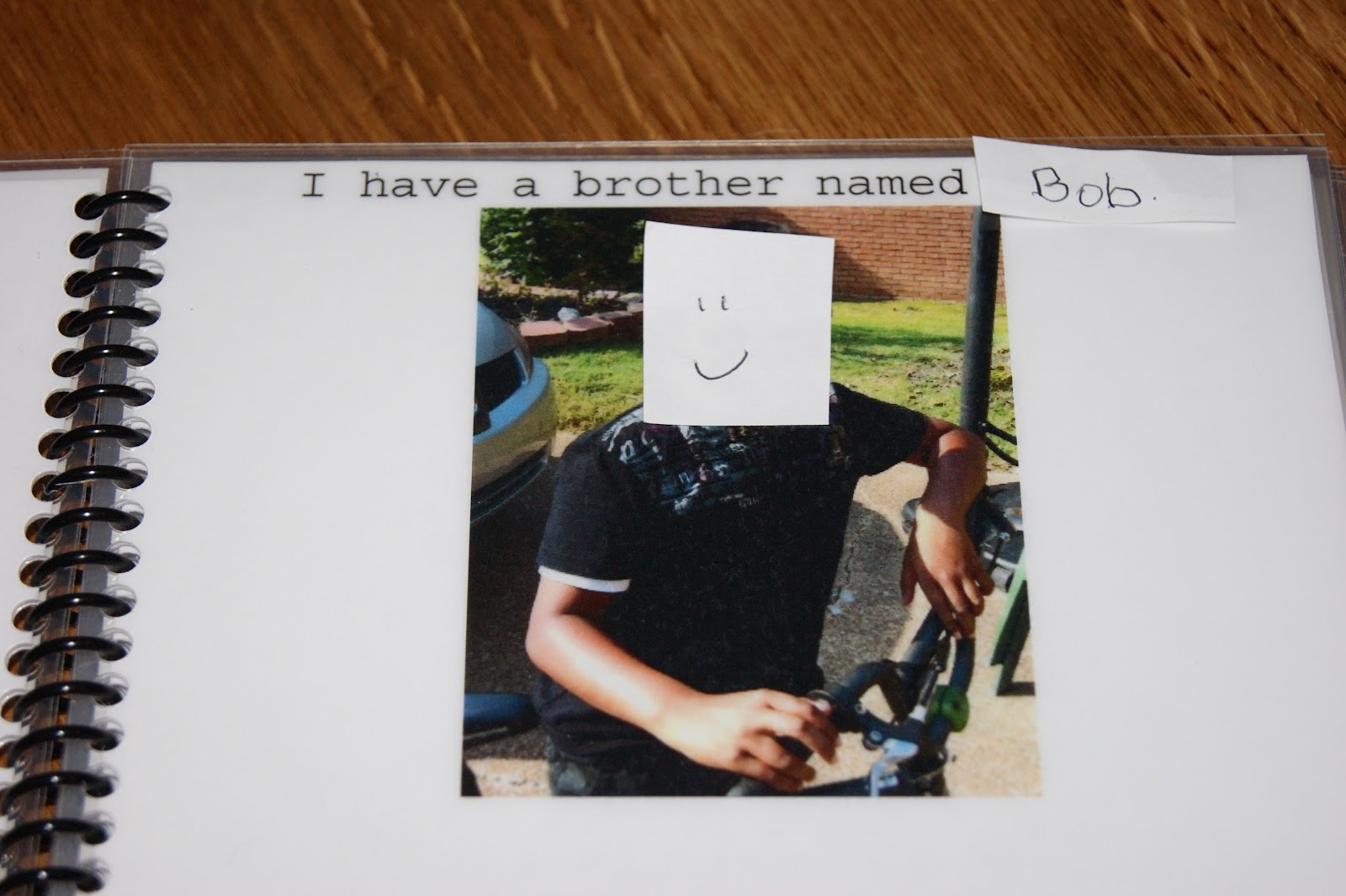
Here is a fun social story that I put together for a parent who was having some challenges with his child's behaviors at home. He shared that his oldest son was having difficulty playing nicely with his younger brother, not wanting to share toys and having tantrums at times. Here is the social story booklet that I put together for them. Whenever possible, I like to use actual photographs in my social stories because I think that children can relate to the story on a more personal level. (I have covered the photos and the boys names to maintain their privacy.) 
  
If you have difficulty reading the text, it says: 


I play nicely with my brother.
My name is Joe.
 I have a brother named  Bob.
Sometimes Bob and I play together.
Lots of times we have fun playing together.

But sometimes we both want to play with the same toy.

I don't like to share the toy with my brother. This makes me angry and I sometimes have a tantrum.

When I have a tantrum, I usually hit my brother, lean on him, and pull his shirt.

But if I hit my brother, and do those things, he will get hurt and won't
want to play with me any more.


I like to play with Bob.

When I don't want to share a toy with Bob, instead of having a tantrum and hitting, leaning or pulling Bob's shirt, I will watch a video on You Tube to make me feel better.

I like my brother. I will not hurt him.


Dear Readers, If you have found my blog to be helpful, please "like" my Facebook page and follow my blog...I'm trying to get my book published and this would be a great help! Thanks :) 

Notice that as an alternative to the negative behaviors (tantrum, hitting, leaning, etc.) Joe is given something else to do that makes him feel better. I specifically asked what he liked to do that would be a positive alternative to the tantrum (watch a video on You Tube) and included that in the social story. This could be listening to calming music, singing a song, jumping on a trampoline, or any other positive alternative.

Social stories are great tools for building social skills! 


Sunday, December 4, 2011

Transition Strategies for Children with Autism and Asperger’s Syndrome


Students who are diagnosed with autism or Asperger’s syndrome frequently deal with anxiety when there are changes in routine, at home or school. This is because this syndrome influences the frontal lobes of the brain, which controls executive functioning. Executive functioning controls the ability to alter one’s mental mindset, or transition from one task or place to another. This area of the brain also sends a message to wait. Today, I am going to share some suggestions that will help prepare these children for transitions.
When a student struggles with transitions between activities due to anxiety related to changes in routine, this can sometimes lead to tantrums and emotional meltdowns. Here are several techniques that can help transitions go more smoothly for autism and Asperger’s students.
·      Timers can also be helpful when dealing with transitions. The timer is set, giving the student a visual of how much time is left until their present activity has to end.
·      Picture Charts/Visual Schedules- A chart that plainly show each activity that occurs during the school day. It is best to have an individual picture for each task or activity. These pictures can be attached or removed by using Velco. Every time a task ends, the picture can be removed. It can be easier for the students to deal with transition if preferred and non-preferred activities are alternated.

·      Verbal prompts- these work with will older students who understand the concept of time. For example, as statement such as "Reading ends in five minutes, then it will be time for lunch." Student should be informed when an unpredictable events like a fire drill or assembly can is to take place. Such activities can be added to the visual schedule, or the teacher can write the information about the event on the board.

·      Natural ending times- provide reminders that a transition is eminent. For example, "when the classroom lesion is over, it's time for us to get ready for lunch."

Try some of these strategies and be willing to work with the unique needs of these students when it comes to transitions.

If you've found this post helpful, please like my Facebook page in the upper right corner! Thanks!

Wednesday, November 2, 2011

An Interactive Social Story


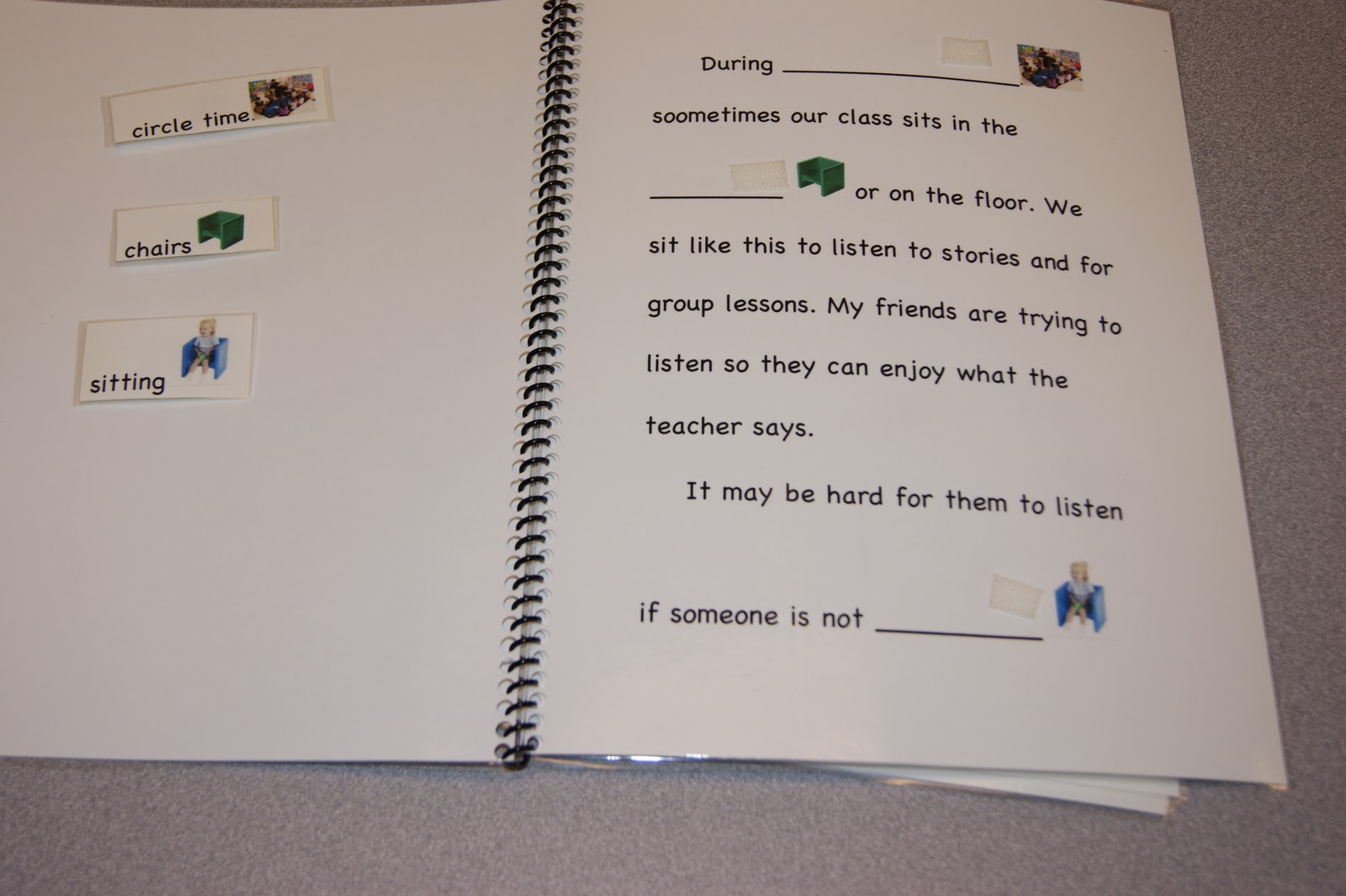
I recently made several interactive social story booklets for a student and I liked the way they turned out, so I decided to share one on my blog! As you can see in the photo, I typed the story, but where certain words should go, I typed blanks and also inserted small photos. I then laminated the pages and attached small pieces of sticky hook Velcro just above the blanks. (See photo) 

      Finally, I typed the words that belonged in the blanks, pairing them with the photos, cut them into small rectangles, laminated them, and put small pieces of sticky loop Velcro on the back. I took the pages to Kinko’s and had them bound and voila, I had a social story booklet! As I read the story, my student likes to find the correct word/photo and Velcro it onto the corresponding space. For a child with a limited attention span, this is a fun way to keep them attending to the story!  
      Social stories were developed by Carol Gray and they provide a way to teach social skills to children with autism and other disabilities. These stories provide information about certain situations that a child may find challenging that he would not understand naturally. The story describes the situation in detail and teaches basic social skills by describing the appropriate responses that would occur in that situation.

How to write a social story
  • The special needs child should be the main character.
  • Make the setting of the story familiar to the child.
  • Specifically describe the other characters in the story, making them familiar if possible.
  • Make the dialog realistic and appropriate child’s ability-level.
  • The important story points should be repeated.
  • If possible, use photographs of the child or his peers.
  • Read the story to the child as frequently as possible.
 Carol Cray recommends at least two descriptive sentences for every directive sentence in the story. Good luck!

Dear Readers, If you have found my blog to be interesting or helpful, please click here and "like" my facebook page...I'm trying to get my book published and this would be a great help! Thanks :)

Tuesday, October 18, 2011

Teaching Strategies for Students with Autism


Are you the parent of a child diagnosed with autism or Asperger’s Syndrome? Do you teach a student who is on the autism spectrum? Are you looking for some effective teaching strategies to use when working with autistic students? If so, I’d like to tell you about an amazing book that I just finished reading!  Success Strategies for Teaching Kids with Autism is a reader-friendly book that includes a variety of evidence-based teaching tools and activities that are based on the applied behavior analysis (ABA) approach.

I especially love this book because it includes a plethora of examples of specific teaching strategies for working on social skills, language skills and behavior, making it the perfect resource for teachers and parents! It is available on Amazon, so just click here for more information or to order your very own copy!

For a chance to win a copy of this book, like my Facebook page (upper right corner of this page), and sign up for my newsletter by clicking HERE and filling out the required information.

Dear Readers, If you have found my blog to be helpful, please click here and "like" my facebook page...I'm trying to get my book published and this would be a great help! Thanks :)


Dear Readers, If you have found my blog to be helpful, please "like" my Facebook page and follow my blog...I'm trying to get my book published and this would be a great help! Thanks :) 

Sunday, October 16, 2011

Communication Aids for Children with Autism

Many of the autistic students that I work with are non-verbal. Can you imagine how frustrating it must be to be unable to express yourself, make choices, and have some control over your environment? I've found that using a simple communication aid in the therapy setting can make a huge difference for students with communication challenges. Initially, I tried using some of the commercially available picture communication cards, but some students didn't quite seem to understand the meanings of the drawings, so I decided to try actual photographs. (A fellow blogger @ http://linkitupcard.blogspot.com/ shared that what I'm using is officially called a "choice board" in the SLP literature!)

For example, when a student comes to therapy and our first activity is going to be sensory-based, I will show them the following communication aid:

This is just a file folder cut in half that has been laminated. I took pictures of the therapy ball, the sit-n-spin, and the bolster swing and laminated them as well. There are three blue rectangles at the top of the page and one red rectangle at the bottom of the page. I used velcro to attach the pictures to the file folder. When I initially present the communication aid, all three pictures are at the top of the page. I ask the student, "what do you want to do?"

Typically, when I try this with a student that has never used the system before, the student will run to the actual item and touch it or gesture that this is what they want to do.  Of course that is great, because the student is communicating in a functional way, but since I'm wanting to teach them to use the communication system, I'll take the students hand and guide them in moving the card for their selected activity to the bottom square. I also add a verbal component, such as, "good, you want the sit-n-spin," as I'm moving the card. It usually doesn't take long for the student to catch on...in many instances after only one demonstration, students will start using the cards to make selections.

When teaching a child to use a communication system such as this, I always start with activities that the child prefers. Once the student has an understanding of how to use the system, I'll have the student choose from tasks that he may not be as crazy about, such as writing, lacing, and cutting. This gives the student some control over the environment by giving him a choice, even if it's from the lesser of three evils! It is so exciting to see a student making choices and communicating during therapy. Parents can use a system similar to this so that a child can make some choices at home, such as what to eat for dinner. If you haven't already, I hope you'll give a communication aid such as this a try. All you need is a camera, a file folder, a marker, velcro and a laminating machine (Kinkos laminates for a small fee)! If you have questions, just leave a comment...I'll be glad to help out!

For more great strategies for teaching kids with autism, click here to go to Amazon and order this book...it is a wonderful resource! 

Wednesday, October 12, 2011

Helping Children with Autism Deal with Transitions


Autism is a term that describes a group of complex developmental brain disorders known as Pervasive Developmental Disorders (PDD). “The other pervasive developmental disorders are PDD-NOS (Pervasive Developmental Disorder – Not Otherwise Specified), Asperger Syndrome, Rett Syndrome and Childhood Disintegrative Disorder. Many parents and professionals refer to this group as Autism Spectrum Disorders” (Autism Speaks Website).

It is estimated that one child in every 110 will be diagnosed with Autism, with the diagnosis being 3 to 4 times more common in boys than girls. A large number of Autistic students are referred for school occupational therapy services. I have discovered a number of techniques that are quite effective when working with these students and I'm going to be sharing some of them with you.

One area that can be particularly challenging for Autistic students is dealing with transitions, especially unexpected transitions. One way to help an Autistic child work through a transition is to use cards like these: 

I made these cards out of construction paper, then laminated them. The red one says "Stop", the yellow says "1 minute", and the green says "Go". When the student begins an activity, I give the student the "Go" card, signaling that there is plenty of time to work on the activity. When it's almost time for a transition, I remove the green card, then hand over the yellow card. This means that there is "One Minute" left until the activity must end. After one minute, I remove the yellow card and hand the child the red card and say it's time to "Stop". This is a great way to help a child deal with transitions because it provides a visual as well as a tangible item that can be held and manipulated. If you work with a child that has a difficult time with transitions, you may want to give this strategy a try!   


Dear Readers, If you have found my blog to be helpful, please click here and "like" my facebook page...I'm trying to get my book published and this would be a great help! Thanks :)


Also, For more great strategies for teaching kids with autism, click here to go to Amazon and order this book...it is a wonderful resource! 

Tuesday, October 11, 2011

Social Stories for Children with Autism and Asperger Syndrome

The concept of social stories was developed and trademarked by Carol Gray, an author and Autism specialist. Social stories are a tool for teaching social skills to children diagnosed with Asperger Syndrome and Autism as well as other disabilities. For more information on social stories, click on the following link:   Social Stories Article