Showing posts with label Social Stories. Show all posts

Saturday, November 16, 2013

A Special "Social Story" to Help Your Child Deal with Feelings of Anger


                                                     http://www.brightkidbooks.com           

Many of you know that I’m a huge fan of social stories! All children need to learn how to deal with feelings of anger and frustration, and for children with special needs, understanding and controlling emotions can be a real challenge. That’s why I’m excited to share one of my new favorite children’s books with you!  “Liz Tames aDragon (and Her Anger)” is written by Stephanie Painter and illustrated by Jeanne Seagle. Stephanie has an educational background in counseling and writes about child development and family issues for various parenting publications.

Technically, “Liz Tames a Dragon” is not traditional “social story,” but as soon as I read it, I thought of all the special needs children who could benefit from this book. This book will help children learn to recognize feelings of anger, and it provides “healthy” strategies for managing those feelings. The illustrations are absolutely amazing and depict the story perfectly! To read more about “Liz Tames a Dragon (and Her Anger) or to purchase the book, click HERE.

(For more information and the history of social stories, click HERE).


Monday, July 30, 2012

Social Story for Playing Nicely

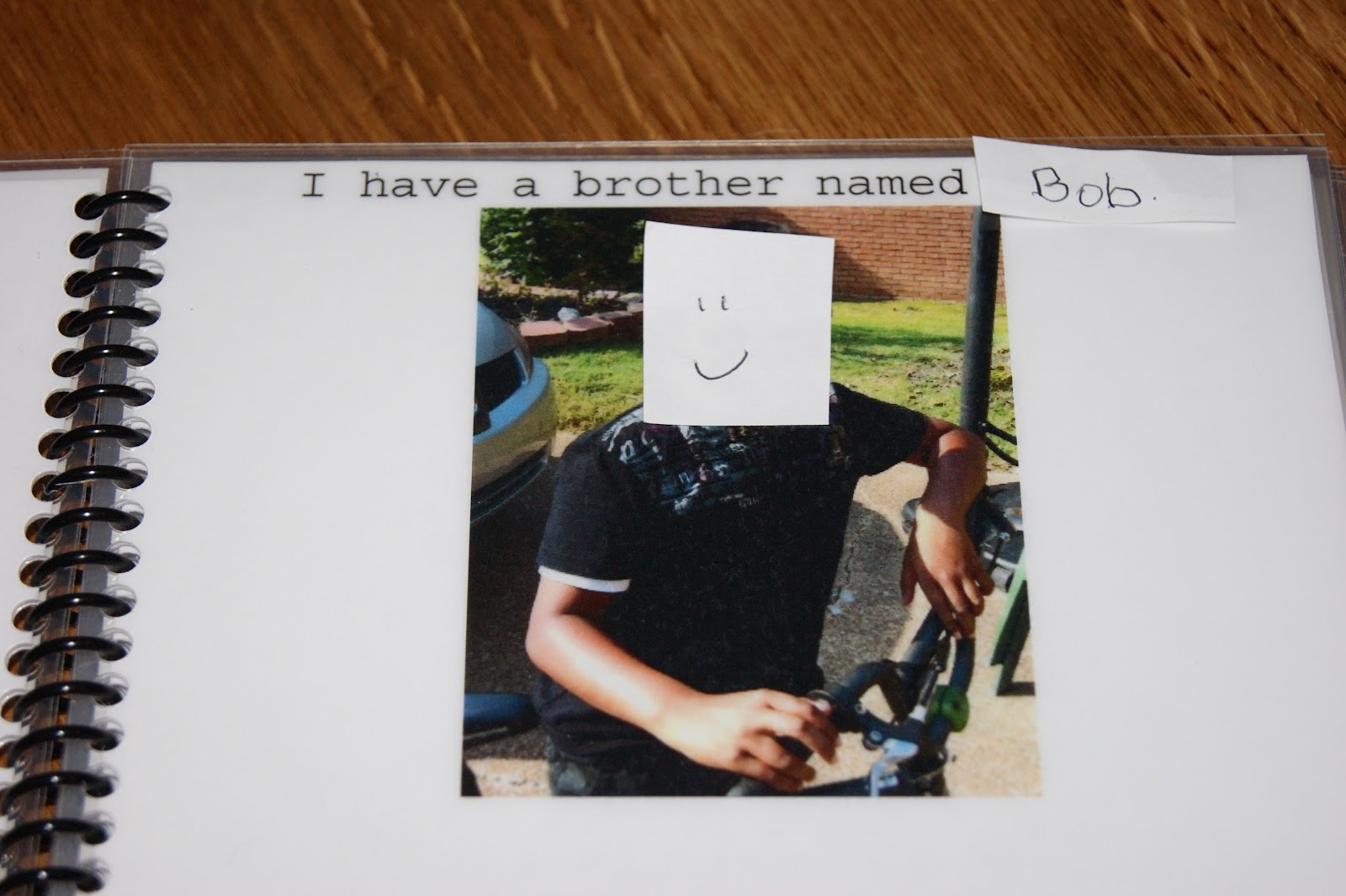
Here is a fun social story that I put together for a parent who was having some challenges with his child's behaviors at home. He shared that his oldest son was having difficulty playing nicely with his younger brother, not wanting to share toys and having tantrums at times. Here is the social story booklet that I put together for them. Whenever possible, I like to use actual photographs in my social stories because I think that children can relate to the story on a more personal level. (I have covered the photos and the boys names to maintain their privacy.) 
  
If you have difficulty reading the text, it says: 


I play nicely with my brother.
My name is Joe.
 I have a brother named  Bob.
Sometimes Bob and I play together.
Lots of times we have fun playing together.

But sometimes we both want to play with the same toy.

I don't like to share the toy with my brother. This makes me angry and I sometimes have a tantrum.

When I have a tantrum, I usually hit my brother, lean on him, and pull his shirt.

But if I hit my brother, and do those things, he will get hurt and won't
want to play with me any more.


I like to play with Bob.

When I don't want to share a toy with Bob, instead of having a tantrum and hitting, leaning or pulling Bob's shirt, I will watch a video on You Tube to make me feel better.

I like my brother. I will not hurt him.


Dear Readers, If you have found my blog to be helpful, please "like" my Facebook page and follow my blog...I'm trying to get my book published and this would be a great help! Thanks :) 

Notice that as an alternative to the negative behaviors (tantrum, hitting, leaning, etc.) Joe is given something else to do that makes him feel better. I specifically asked what he liked to do that would be a positive alternative to the tantrum (watch a video on You Tube) and included that in the social story. This could be listening to calming music, singing a song, jumping on a trampoline, or any other positive alternative.

Social stories are great tools for building social skills! 


Wednesday, November 2, 2011

An Interactive Social Story


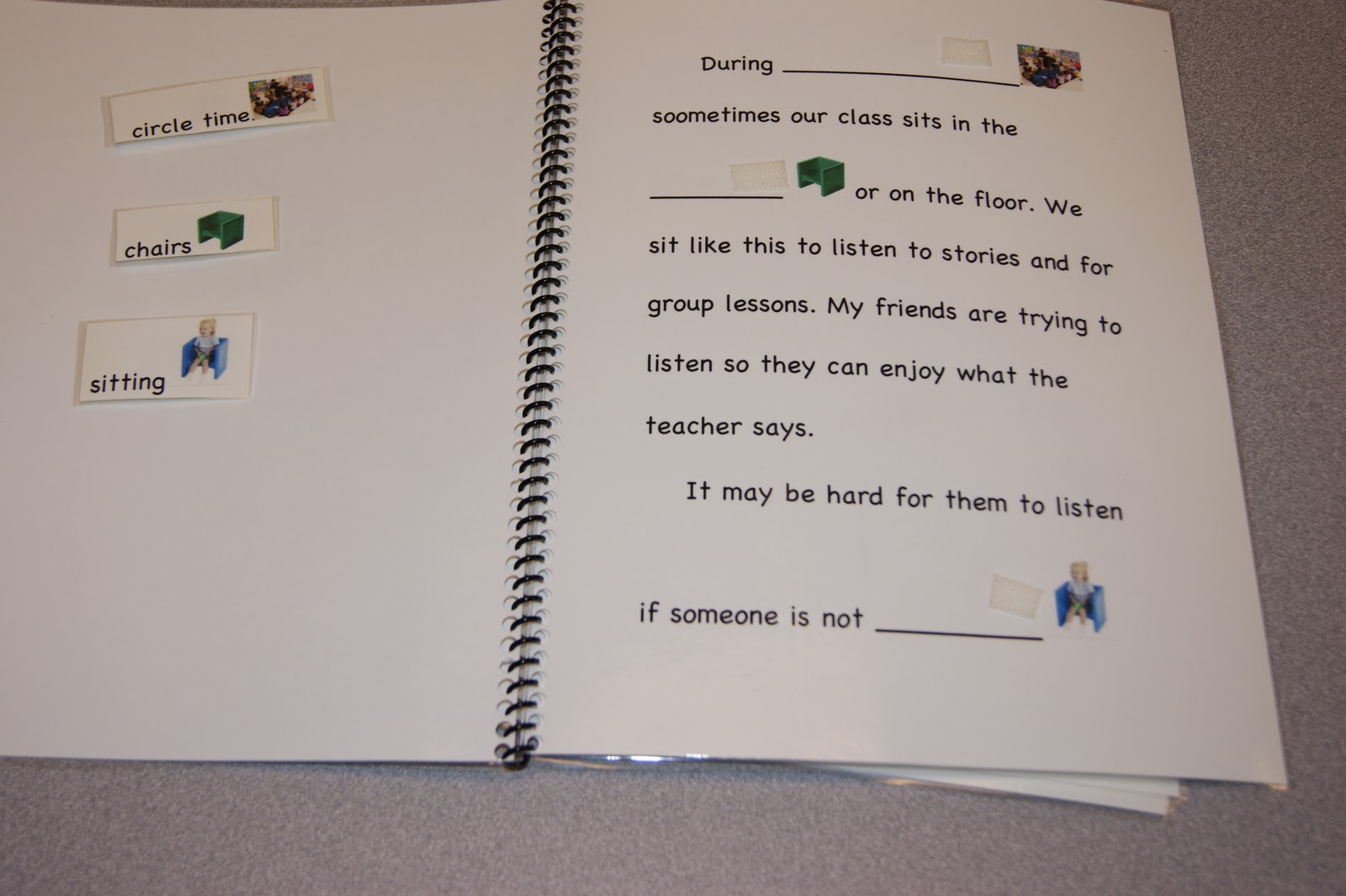
I recently made several interactive social story booklets for a student and I liked the way they turned out, so I decided to share one on my blog! As you can see in the photo, I typed the story, but where certain words should go, I typed blanks and also inserted small photos. I then laminated the pages and attached small pieces of sticky hook Velcro just above the blanks. (See photo) 

      Finally, I typed the words that belonged in the blanks, pairing them with the photos, cut them into small rectangles, laminated them, and put small pieces of sticky loop Velcro on the back. I took the pages to Kinko’s and had them bound and voila, I had a social story booklet! As I read the story, my student likes to find the correct word/photo and Velcro it onto the corresponding space. For a child with a limited attention span, this is a fun way to keep them attending to the story!  
      Social stories were developed by Carol Gray and they provide a way to teach social skills to children with autism and other disabilities. These stories provide information about certain situations that a child may find challenging that he would not understand naturally. The story describes the situation in detail and teaches basic social skills by describing the appropriate responses that would occur in that situation.

How to write a social story
  • The special needs child should be the main character.
  • Make the setting of the story familiar to the child.
  • Specifically describe the other characters in the story, making them familiar if possible.
  • Make the dialog realistic and appropriate child’s ability-level.
  • The important story points should be repeated.
  • If possible, use photographs of the child or his peers.
  • Read the story to the child as frequently as possible.
 Carol Cray recommends at least two descriptive sentences for every directive sentence in the story. Good luck!

Dear Readers, If you have found my blog to be interesting or helpful, please click here and "like" my facebook page...I'm trying to get my book published and this would be a great help! Thanks :)

Tuesday, October 11, 2011

Social Stories for Children with Autism and Asperger Syndrome

The concept of social stories was developed and trademarked by Carol Gray, an author and Autism specialist. Social stories are a tool for teaching social skills to children diagnosed with Asperger Syndrome and Autism as well as other disabilities. For more information on social stories, click on the following link:   Social Stories Article