Showing posts with label Infant & Child Development. Show all posts

Thursday, September 3, 2026

What Toddlers May Be Communicating Through Their Behavior

By Anissa C. Weimer, MS, CCC-SLP
Toddlers have a lot to say—often much more than they have the words to express.
 
They have opinions about which cup they want, ideas about what they want you to do, excitement they want to share, and very definite thoughts about what should happen next. The problem is that their ability to communicate those thoughts and others is still developing.
 
Sometimes, that gap between what a toddler wants to communicate and what they are able to express shows up through behavior. 
A toddler who pulls you across the room may be saying, “Come see!” A child who pushes something away may mean, “I don't want that.” Repeating the same word louder and louder may be less about refusing to cooperate and more about, “You're not understanding me.” Crying when you offer what you thought they requested may simply mean, “That's not what I meant.”
 
Of course, not every challenging toddler behavior is about communication. Toddlers become tired, hungry, overwhelmed, frustrated by limits, and upset by transitions just like the rest of us. But behavior gives us information. Sometimes asking “What might my child be trying to communicate?” can help us see a situation differently. 
When You Don't Understand, Try “Show Me”
 
I learned this lesson with my own daughter.
In the second book in my Little Voices Big Futures series, The Toddler Transition, I share the story of her running to me at about 30 months old, excitedly repeating what sounded like “turdee.” I couldn't figure out what she was saying. The more I asked, the more frustrated she became.
 
Finally, instead of asking her to repeat herself again, I said, “Show me.”
 
She grabbed my hand and led me to the garage—where she proudly showed me a turtle.
 
Her growing frustration hadn't been the message. It was the result of having a message she desperately wanted to share and not being understood. 
 
“Show me” is a simple strategy parents can try when words aren't working. Let your toddler point, gesture, bring you an object, or lead you somewhere. Once you understand, give them the language that goes with the message: “Turtle! You found a turtle!” or “You want me to open it. Okay!”
 
You're showing your child that communication is bigger than perfectly spoken words.
 
Create a Little Communication Opportunity
 
Play gives us another way to help toddlers discover that their communication matters.
 
Try creating a small, playful problem. Give your child a favorite toy in a container they need help opening. Put a desired toy slightly out of reach. Build a block tower and let it tumble down.
Then pause.
 
Instead of immediately solving the problem, watch what your toddler does. Do they look at you? Point? 
Make a sound? Hand you the container? Reach toward the toy? Say a word?
 
Respond to that attempt, then add simple language: “Help?” “Open!” “You want the car.”
 
As I discuss in The Toddler Transition, toddlers begin learning that communication has power when they make a sound and someone responds, gesture and someone reacts, or use a word and something happens. 
 
Look for the Message
 
The goal isn't to analyze every tantrum or eliminate normal toddler behavior. It's simply to become curious about what may be underneath it.
 
Sometimes a behavior is just a behavior, but often, there's a little voice behind it saying:
 
“I don't want that.” 
 
“Help me.”
 
“I'm overwhelmed.” 
 
“I need a break.” 
 
“I don't understand.”
 
When we look for the message behind the behavior, respond to what our toddlers are trying to tell us, and model the words they need to express it, we do more than help them feel understood in the moment. We give them the language to communicate more clearly—and show them that their voice matters.
 
Order your copy of "The Toddler Transition" book by clicking HERE! 
 
About the Author: 
Anissa C. Weimer, MS, CCC-SLP, is a speech-language pathologist, former educator, and author of the Little Voices Big Futures series. Her work focuses on helping parents and caregivers understand early communication development and use practical, everyday strategies to support their children’s growing communication skills. The Toddler Transition, the second book in the series, focuses on communication development from 18 to 36 months, including milestones, communication concerns, and play-based strategies families can use at home. Learn more about Anissa, the series, and additional resources at https://www.LittleVoicesBigFutures.com
 

Wednesday, February 14, 2024

Creative Ideas for Tummy Time Fun!!!

When implementing tummy time with your baby, it's a good idea to get creative! Creativity can be helpful because many infants resist being positioned on the stomach for play. That is because they often aren't familiar with the position, so it is difficult for them. Yet, tummy time is extremely important because it promotes head control, and strengthens the trunk, shoulder, arm, and hand muscles.

Here are some tips for helping your infant better tolerate tummy time!

1. Start early! You can initiate tummy time during the first days of your infant's life. When you are in a reclined position, place your baby on your chest so that the two of you can see eye to eye! Yes, this counts as tummy time.

2. Take it slow. You may have to start with sessions that are only 15 to 30 seconds long. That's okay! Your infant's tolerance will gradually improve and as that happens, you can stretch time of each session.

3. Mix it up. Tummy time does not have to take place on the floor. You can position your baby on the tummy across your lap when you are seated, when you are holding them, or even on a therapy ball.

4. Always provide direct supervision during tummy time. If your infant starts to fuss or cry, don't hesitate to change their position. It's not a good idea to force tummy time, as this might cause your baby to resist the position even more.

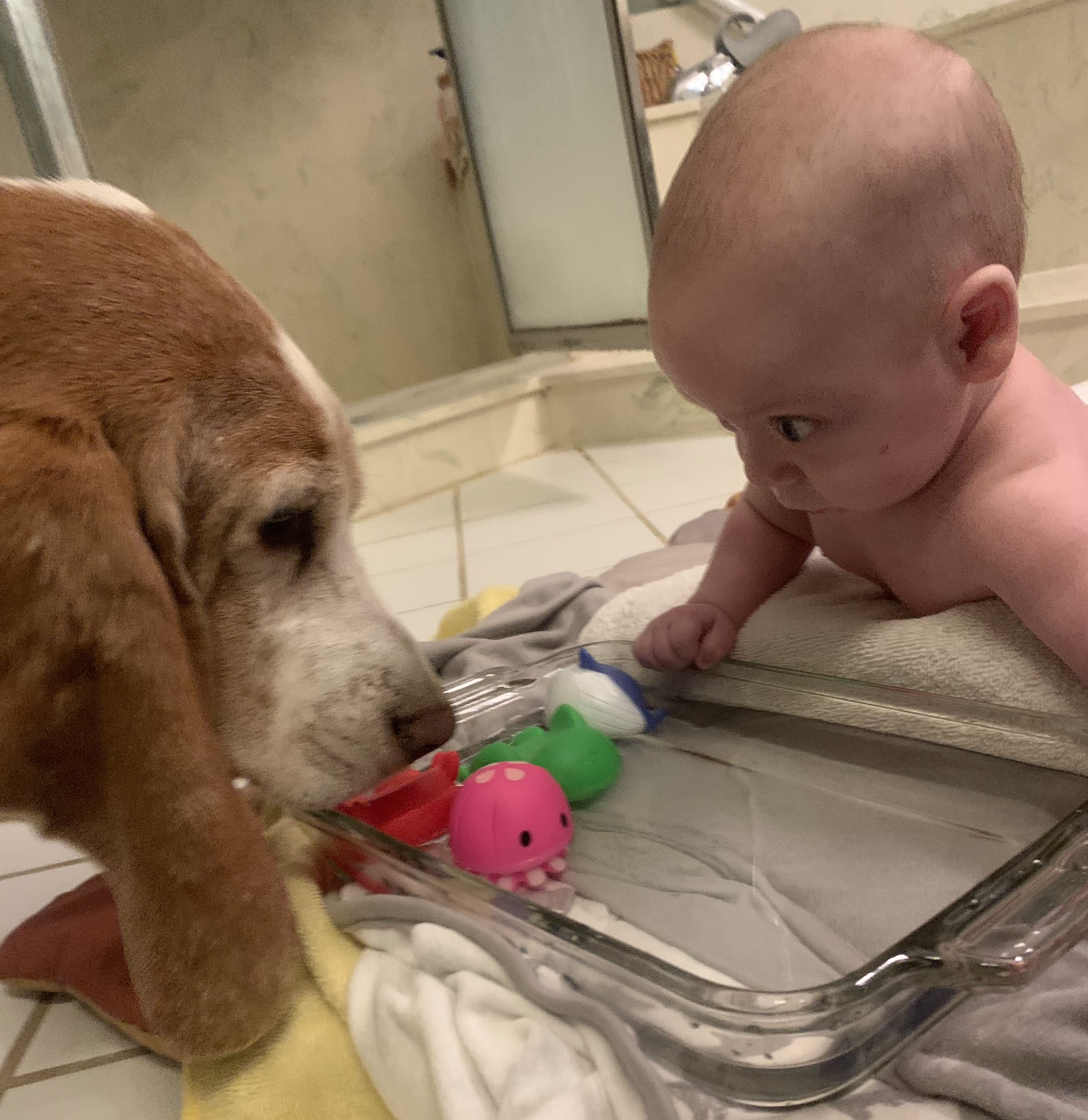
5. Get creative! As you can see in the photo above, you can incorporate entertaining activities, siblings, and even pets into your infant's tummy time sessions! Do you have any creative suggestions for tummy time? I would love to hear them. Feel free to share your ideas below.


Saturday, October 28, 2023

How To Get Baby To Sleep Through The Night

Do you have problems with your baby sleeping through the night? Maybe he falls asleep just fine, but then he wakes up in the night and calls out for you. This can be even more of a problem when baby gets big enough to climb out of bed and comes to Mommy and Daddy’s room. If you are dealing with any of these situations, you may want to consider establishing a regular bedtime routine for your little one. Read on to discover how to get baby sleeping through the night. 

Have a Routine

Research suggests that establishing a consistent bedtime routine for infants and toddlers helps a baby to fall asleep more quickly, and it even increases the duration of their sleep. Studies have found that toddlers who follow a bedtime routine each evening are less likely to call out to their parents or crawl out of the crib during the night. Interestingly, the mother’s mood also improved significantly once a regular bedtime routine was established. (Probably because she’s getting more sleep!)

Exactly why does this make a difference? Babies need to learn how to fall asleep on their own, without being rocked or having a parent in the room. If baby associates sleep with being rocked or having a parent close, when she wakes in the night, she will need one of these to fall back asleep. Obviously, she will cry or call our for Mommy to come rock her back to sleep, and this cycle will repeat itself every time she wakes in the night.

Stick with it

Starting a bedtime routine may be difficult at first, especially if your child is used to being rocked to sleep. You’ll have to put your infant in the bed and he will have to learn to fall asleep on his own. This will probably mean crying himself to sleep. At first. I’ll admit, I had a very difficult time with this, and my husband had to help; however, after a couple of nights, the crying did not last as long, and it wasn’t long before everyone in the family was sleeping all night. 

A bedtime routine provides a smooth transition from an active day to the calmness of sleep. A basic routine such as putting on pajamas, brushing teeth (when baby is old enough), reading a story, and a goodnight kiss lets a child know what to expect every evening. An added bonus is that children usually love having their parent’s undivided attention! The time together before a child falls asleep is the perfect time to stay connected. So if you haven’t already started this wonderful habit, do it tonight!


Tuesday, June 20, 2023

Children learn through play!


 Image courtesy of nenetus at FreeDigitalPhotos.net

Children learn about the world around them through exploration and play. The role of play in child development is important for the development gross motor, fine motor and social skills. Play can be as simple as imitating the sounds that your infant makes, or it can be more involved, such as putting puzzles together, stacking blocks and imitating complex block patterns. Play activities such as these are great for motor and perceptual development, and they are also wonderful for social skill development.

Parents and caregivers need to have a basic understanding of developmental milestones in childhood. This knowledge will be helpful when encouraging your child come up with ideas for play.

Here is a brief early developmental milestone chart of skills that influence play. Please keep in mind that all children develop at their own individual rates, so the ages for acquiring these milestones may vary from child to child.

Begins to show interest in and curiosity about the environment – 4 to 6 months
Object permanence emerging/pointing to pictures and objects- 10 months to 1 year
Imitation and solitary play skills- 1 year to 15 months
Parallel play and symbolic play- 2 years
Interactive play and taking turns- 2 ½ to 3 years

Monday, January 16, 2023

The Importance of Reading!!!


Early exposure to reading increases a child’s chances of future academic success. Reading experience, as well as exposure to rich conversations, help improve a child’s vocabulary and ability to communicate.

This is not good news for children who live in poverty. Research has found that there are a dozen or more books per child in neighborhoods with average incomes; however, in poor neighborhoods you will only find one book for every three hundred children. Additionally, there is significantly less conversation between these parents and their children. These issues lead to limited exposure to reading for children living and poverty.

What does this mean? By the time they are school age, these children have 25% of the vocabulary than children from middle-income neighborhoods, which puts them below the national norms with language and prereading skills.

Many organizations in the United State are working to decrease this gap, by making books available to those who cannot afford them. They are working to increase the access of low-income families to books. For more information, visit their websites.

Dolly Parton's Imagination Library 

Reading is Fundamental

First Books

Photo Credit: Stephen Andrews @ Unsplash

Wednesday, May 25, 2022

How to reduce the risk of Sudden Infant Death Syndrome

In one year, all across this country, approximately 2,500 infants die of Sudden Infant Death Syndrome, also known as SIDS. SIDS awareness is critical. If you are not familiar with that term, SIDS is the unexpected death of an apparently healthy infant during sleep. Prior to 1992, most babies in the United States slept on their stomachs. In 1992, after researchers discovered that infants were approximately 12 times more likely to be found on their stomachs than on their backs when they had died of SIDS, the American Academy of Pediatrics (AAP) recommended that all infants be placed to sleep on their backs or sides. Later, the side position was eliminated from the recommendation because infants could roll from their sides to their stomachs in their sleep. Since that original sleep position recommendation was made by the AAP in 1992, 50% fewer infants have died from SIDS. Putting babies to sleep on their backs turned out to be a simple and effective way to reduce the risk of Sudden Infant Death Syndrome!

                                                               Photo Credit: Free Digital Photos.net

Following these recommendations reduces the risk of SIDS.

  • Position your infant on their back to sleep. 
  • Use a firm, flat sleep surface.  
  • Your baby can be brought into your bed for feeding or comforting, but return your baby to her back in her crib when you are ready to go to sleep.  
  • Bed-sharing is not recommended for any babies.  
  • Room share by keeping baby’s sleep area in the same room where you sleep, ideally for the first 6 months.  
  • Keep soft objects, loose bedding, or any objects that could increase the risk of entrapment, suffocation, or strangulation out of the baby’s sleep area.  
  • Do not let your baby fall asleep on nursing pillows or pillow-like lounging pads.  
  • Never place your baby to sleep on a couch, sofa, or armchair.  
  • It is fine to swaddle your baby. However, make sure that your baby is always on her back when you swaddle her.  
  • Try giving a pacifier at nap time and bedtime.  
  • Set up a separate but proximate sleeping environment.  
  • Do not smoke or use any nicotine products during pregnancy or around your baby. Secondhand smoke increases baby’s risk of SIDS. 
  • Avoid alcohol, marijuana, opioid, and illicit drug use during pregnancy. 
  • Don’t let your baby overheat. She should be lightly clothed for sleep, with the bedroom temperature remaining comfortable.  
  • Use a crib, bassinet, or play yard. These have safety standards. Never let your baby sleep on a couch, armchair, cushion, or adult bed.  
  • Avoid commercial devices marketed to reduce the risk of SIDS. Research reveals that sleep positioners (flat or wedged mats with side bolsters) pose a risk of suffocation because a baby can get trapped and suffocate between the sleep positioner and the side of a crib or bassinet. 
  • Don’t let your baby share a bed.  
  • Breastfeeding is recommended.  
  • Pregnant women should receive regular prenatal care.  
  • Do not rely on home monitors as a strategy to reduce the risk of SIDS. 
  • There is no evidence that home monitors decrease the incidence of SIDS. 
  • Keep immunizations up to date. 
Dear Readers, If you have found my blog to be helpful, please click here and "like" my facebook page...I would really appreciate it! Thanks :)

Friday, May 25, 2018

Developmental Milestone Chart: 30 to 36-Months

It’s a busy time for your toddler!  She is putting sentences together of 4 to 5 words, and she is now able to follow simple instructions which is nice.  She is also probably engaging in pretend play and enjoys playing with a playground ball. The developmental milestone chart below lists many of the different skills that typically emerge between 30 and 36-months of age.
http://drannezachry.com/wp-content/uploads/2018/05/Milestones_30-36-Months.pdf

The project above was completed by Master of Occupational Therapy students at The University of Tennessee Health Science Center and posted with permission.

Friday, March 23, 2018

Developmental Milestone Chart: 24 to 30-Months

What an exciting time!  Your toddler is likely talking more every day, and she may even have started engaging in pretend play. The developmental milestone chart below lists many of the different skills that typically emerge between 24 and 30 months of age.

     Click HERE to download a copy of the chart.


The project above was completed by Master of Occupational Therapy students at The University of Tennessee Health Science Center and posted with permission.

Monday, December 25, 2017

Developmental Milestone Chart: 18 to 24-Months

Your 18 to 24-month old baby is growing and learning new skills quickly. He is likely knows the meaning of simple objects, names items in a book, understands simple verbs.  The following developmental milestone chart will give you an idea of what do expect during the next few months.
http://drannezachry.com/wp-content/uploads/2017/12/18-24-Months_Dev-Milestones.pdf
 The project above was completed by Master of Occupational Therapy students at The University of Tennessee Health Science Center and posted with permission.

Saturday, October 28, 2017

Developmental Milestone Chart: 12 to 15-Months

Your 12 to 15-month old baby is learning new skills at a rapid rate. He is likely pointing to get the attention of others, drinking from a cup and feeding himself a snack.  The following developmental milestone chart will give you a general idea of what do expect during the next few months.
References

Brill, A. (2017, March 16). Giant List of Self-Care Skills for Babies,Toddlers and Preschoolers. Retrieved from http://www.positiveparentingconnection.net/giant-list-of-self-care-skills-for-babiestoddlers-and-preschoolers/

Gross & Fine Motor Milestones. (n.d.). Retrieved August 08, 2017, from http://www.cwtherapy.com/resources/milestones/gross-fine-motor-milestones/#fifteenmonths

Gross Motor Skills Milestones for Toddlers 12 - 24 Months | EIS. (2015, April 02). Retrieved from http://day2dayparenting.com/gross-motors-skills-toddlers-aged-12-24-months/

Important Milestones: Your Child By Eighteen Months. (2016, August 15). Retrieved August 08, 2017, from https://www.cdc.gov/ncbddd/actearly/milestones/milestones-18mo.html

Physical Development of Toddlers From 12-18 months. (n.d.). Retrieved from https://www.healthyfamiliesbc.ca/home/articles/physical-development-toddlers-12-18-months

Toddlers' Social and Emotional Development From 12-18 Months. (n.d.). Retrieved from https://www.healthyfamiliesbc.ca/home/articles/toddlers-social-and-emotional-development-12-18-months

The project above was completed by Master of Occupational Therapy students at The University of Tennessee Health Science Center and posted with permission.

Wednesday, September 13, 2017

Developmental Milestone Chart: 9 to 12-Months

Developmental Milestone Chart: 9 to 12-Months

From 9 and 12 months, your baby is developing at an extraordinary pace.  She is likely exploring her environment by crawling, and believe it or not, she will be walking and talking soon!  The following developmental milestone chart will give you an idea of what do expect during the next few months.


The project above was completed by Master of Occupational Therapy students at The University of Tennessee Health Science Center and posted with permission.

Sunday, August 27, 2017

Developmental Milestone Chart: 6 to 9-Months

Your 6 to 9-month old is growing and developing skills every day. She knows her name, imitates sounds, and is likely rolling over by now.  The following developmental milestone chart will give you a general idea of what do expect during these months.
 The project above was completed by Master of Occupational Therapy students at The University of Tennessee Health Science Center and posted with permission.

Saturday, August 19, 2017

Developmental Milestone Chart: 3 to 6-Months

Your 3 to 6 month old baby likely enjoys socializing by smiling and cooing at you. This is a fun age!  He has discovered his hands and fingers and explores them with his mouth.  The following developmental milestone chart will give you a general idea of what do expect during this time frame.
Photo/Image Credits:
Liz. (2012, May 30). Pastel ABC baby blocks. [Photograph]. Retrieved from http://sweetclipart.com/pastel-abc-baby-blocks-950
Saaraa. (2015). Infant and elderly: the most prone to burns. [Photograph]. Retrieved from http://www.saaraams.com/blog/infants-and-elderly-the-most-prone-to-burns/

The project above was completed by Master of Occupational Therapy students at The University of Tennessee Health Science Center and posted with permission.

Wednesday, August 16, 2017

Developmental Milestone Chart: Birth to 3-Months

Parents, teachers, and therapists need to understand typical child development and be aware of developmental milestones.  If we know what to expect when it comes to development, then we will know when to consult with the pediatrician if a developmental problem is suspected.  For this reason, I am happy to share a series of posts that will include developmental milestone charts for infants and children ranging in age from birth to 6 years of age.  Here is the developmental milestone chart for an infant ranging in age from birth to 3-months.

The project above was completed by Master of Occupational Therapy students at The University of Tennessee Health Science Center and posted with permission.

Sunday, March 26, 2017

Play and Child Development

 Children learn about the world around them through exploration and play. The role of play in child development is important for the development gross motor, fine motor and social skills. Play can be as simple as imitating the sounds that your infant makes, or it can be more involved, such as putting puzzles together, stacking blocks and imitating complex block patterns. Play activities such as these are great for motor and perceptual development, and they are also wonderful for social skill development.

Parents and caregivers need to have a basic understanding of developmental milestones in childhood. This knowledge will be helpful when encouraging your child come up with ideas for play.

Here is a brief early developmental milestone chart of skills that influence play. Please keep in mind that all children develop at their own individual rates, so the ages for acquiring these milestones may vary from child to child.

Begins to show interest in and curiosity about the environment – 4 to 6 months
Object permanence emerging/pointing to pictures and objects- 10 months to 1 year
Imitation and solitary play skills- 1 year to 15 months
Parallel play and symbolic play- 2 years
Interactive play and taking turns- 2 ½ to 3 years

Sunday, May 3, 2015

The Therapeutic Benefits of Flow: Storytelling Cards


I’m excited to tell you about this fun storytelling card game! Use the 48 beautifully illustrated cards that can be used to make up a story with your client. There are also 4 blank cards that you or your client can use to add characters, places, or objects when making up the story.

The set includes instructions for several different ways to play the game, including “creating a story chain” and “story race.”

In addition to working on storytelling, these cards are perfect for addressing additional skills, such as naming colors, objects, and shapes, as well as sequencing. They are also wonderful for language development, including using adjectives and adverbs appropriately.  The illustrations are appropriate for adult or pediatric clients. For more information, or to order a set, click HERE.

Dear Readers, If you have found my blog to be helpful, please follow my blog (on the right of this page) and click here and "like" my facebook page... 
Thanks :) 

Saturday, January 17, 2015

Motor Skill and Brain-Boosting Developmental Toys for Baby's First Year

Parents often ask me to recommend developmental toys, but I usually recommend simple household objects for play. For example, when children play with empty boxes or pots and pans, they use their imaginations which is wonderful for fostering creativity.  However, new toys at Christmas or on birthdays are always a treat! Here are several of my favorites:

Sassy Ring O' Links Rattle Developmental Toy


These rings are brightly colored which is good for visual stimulation. Babies enjoy shaking and manipulating them, which is wonderful for fine motor skills. I especially like the different textures on the rings!

Fisher-Price Brilliant Basics Rock-a-Stack

This toy is also colorful and the stacking task is nice for developing eye-hand coordination. While your baby is playing with the rings, you can teach him about the concepts of big and small.

Here's another toy that's good for motor skills. Babies love to take and out of containers and put them back in, so this toy typically keeps a child occupied while also addressing eye-hand coordination.  During play, teach him the names and colors of the shapes.

The First Years Stacking Up Cups

Here's another basic stacking/nesting toy that I really love. These are super neat because they have numbers on the bottoms, so your baby can learn about counting as well as color and number recognition, and of course, stacking and placing the toys is wonderful for manipulative skills.


Saturday, December 27, 2014

Developmental Milestones Chart

Newborn

Closes fingers around toy place in hand
Brings hands to mouth
Watches adult’s face when feeding

One to Two Months

Regards a toy in the line of her vision
Holds hands open for a 5 minute period
Shows awareness of hands
Visually follows a toy past midline
Focuses on toy for 5 seconds
Recognizes familiar person
Smiles or gurgles to a familiar person

Three to Four Months

Manipulates hands at midline
Reaches out for toy
Grasps toy crudely
Holds bottle for one minute
Laughs out loud when stimulated
Puts hand in mouth
Raises head and chest when lying on stomach

Five to Six Months

Reaches and attains toy
Bangs in play
Transfers toy hand-to-hand
Grasps tiny toy with palm and fingers

Seven to Eight Months

Shakes rattle in imitation
Grasps toy with thumb and fingers
Pokes at tiny toy with index finger
Picks up food to place in mouth
Responds to name
Shows shyness around strangers
Rolls from back to stomach and stomach to back

Nine to Ten Months
 

Grasps pellet with thumb and index finger
Holds a toy in one hand- reaches with the other
Points with index finger
Good release of objects is present
Responds to image in mirror
Responds to familiar words
Smiles selectively
Sits without support
Crawls

Eleven to Twelve Months

Removes lid from box with no assistance
Places one cube/block in a cup
Removes cover to attain hidden toy
Repeats a performance to draw laughs
Drops a toy deliberately
Brings spoon from bowl to mouth
Temporarily responds to “no” or “stop”
Walks with or without support

Thirteen to Eighteen Months

Pulls to stand
Walks with or without support
Squats down and picks up a toy
Eats with fingers
Turns pages of a board book
Drinks from a cup independently
Throws a ball underhand
Stacks 4 blocks
Removes basic clothing

Nineteen to Twenty-Four Months

Runs with stiff legs
Eats with spoon (some spillage)
Kicks a ball forward with one foot
Scribbles in circles
Jumps in place two times
Points to specifics in a book
Assists with some dressing
Stacks 6 blocks

Sunday, January 19, 2014

Help Your Child Learn Through Experiences!


Children with special needs often struggle with language, motor, and sensory processing skills. Difficulties in one or more of these areas may impact how a child interacts with the world. For example, a child with a language delay may have fewer social interactions throughout the day. Because children learn by engaging with the world around them, it is critical that all children have unlimited opportunities for learning. Here are several strategies for helping a child with special needs learn through engagement. 

-Never underestimate the power of imitation. Imitate your child and encourage her to imitate you. Guide her through the motions if she needs a bit of help. Even if she’s being guided, she will feel the movement and learn from it.

-Exaggerate, exaggerate, exaggerate! Exaggerate your expressions, your voice and every move that you make in order to get and keep your child’s attention. During play, always position yourself in her line of vision. Your child learns through observation, so the more he watches you, the more he learns.

-Reinforcement may be necessary. A child with special needs may not be naturally excited by play and interaction, so keep the motivation high through positive reinforcement. Be sure to use reinforcers that are motivating and meaningful to your chld.

-Keep it simple. Play doesn’t have to be complicated. Break activities down into simple, basic steps in order to increase your child’s opportunities to successfully complete a task. Praise your child for every small accomplishment.

-Make it fun. Try not to “push” your child. Play should be natural and fun and if your child senses that you aren’t having a good time, it’s likely he won’t have as much fun. Laugh as much as possible and have a good time!

Monday, December 23, 2013

Promoting Language Development


Here are a few tips to help your child with language development. 

* Always speak to your child using complete sentence.

* Ask questions that require more than yes or no answers. 

* Play games that include songs and rhymes, such as "Jack and Jill" and "Hickory Dickory, Dock." Always encourage your child to imitate the words.

* Ask questions about the immediate environment. For example, if your folding laundry, ask your child the color of each piece of clothing.

* If your child wants something and she points to the item, tell her to "use your words."

* Read, read, read to your child...you can never overdo reading!