Showing posts with label Visual Perceptual Skills. Show all posts
Wednesday, December 4, 2019
Visual Scanning: More Free Worksheets!
Visual scanning is the ability to use the eyes to search for letters, numbers, symbols, information, etc. from side to side and top to bottom. Efficient visual scanning is important for many life skills, including reading. Not too long ago, I posted several free visual scanning worksheets, click HERE to access them.
Thursday, July 18, 2019
Visual Scanning: Free Worksheets!
When you move your eyes to look for items or information around you, this is
called visual scanning. Visual scanning is important for reading and other school
tasks like writing.
Playing the game "I Spy" is a good way to work on this skill. Also, here are several worksheets for kids that require visual scanning!
Friday, January 5, 2018
Free Visual Perceptual Skills Worksheets!
Visual perceptual skills are how the brain makes sense of the information the eyes take in and gives that information meaning (for example, finding a toy in a toybox). Visual perceptual skills are important for writing, reading, working math problems, and many other skills! Enjoy these fun & free worksheets that will help your child work on her visual perceptual skills.
Friday, September 29, 2017
Free Visual Perceptual Worksheets!!!
Visual perceptual worksheets are a fun way for students to work on visual
perception skills. As a special thank you to my readers, I am sharing these
free visual perceptual worksheets!
The following worksheets address Visual Closure.
Visual Closure
is the ability to visually complete a picture or form that is not in
full view. This skill is important for reading and recognizing words,
forms, etc. in a speedy manner.
Visual-Closure Activities
-Complete pictures in which only parts of objects/shapes are revealed.
-“What is missing” worksheets
-Dot-to-dot activities
-Jigsaw puzzles
-Building three-dimensional models from cubes, cylinders, and blocks
-Connect broken lines to complete a shape or form.
-Partially cover an object or shapes and have the child identify it.
-Figure-ground activities also help with visual closure.
Wednesday, March 30, 2016
Free Visual Perceptual Worksheets!!!
Kids use visual perceptual skills to understand what they see in the environment. Visual perception is needed for writing, reading, and copying from the board. There are many different ways to work on visual perceptual skills. Visual perceptual worksheets can be fun way for kids to improve visual perception. As a special thank you to my readers, I am providing these free visual perceptual worksheets!
For free visual perceptual worksheets, click on the following links:
http://drannezachry.com/wp-content/uploads/2016/03/VP_DC.pdf
http://drannezachry.com/wp-content/uploads/2016/04/Arrow-Worksheet.pdf
Click HERE for more free worksheets!!!
For free visual perceptual worksheets, click on the following links:
http://drannezachry.com/wp-content/uploads/2016/03/VP_DC.pdfhttp://drannezachry.com/wp-content/uploads/2016/04/Arrow-Worksheet.pdf
Click HERE for more free worksheets!!!
Friday, November 20, 2015
Fun DIY Activities for Visual Perceptual Skills
Sponges are one of my favorite "pediatric occupational therapy" items in my therapy bag! There are so many therapeutic activities for basic kitchen sponges! Simply cut the sponges into blocks or shapes of various sizes
and watch any child enjoy making creations. Take a variety of brightly colored sponges, and create a stack in a particular sequence of colors/shape and then have the child re-create the stack.
Another fun activity that is great for visual perceptual skills is to make a variety of worksheets with different shapes that they child can place the sponges on top of to create a design. This is basically an inexpensive tangram game that will challenge a child's visual perceptual skills. The sheets can range from basic to more complex in order to increase the challenge based on the child's skill level! So go to the dollar store and pick up a package of sponges and get ready to have some fun!
Friday, November 28, 2014
Occupational Therapy Activities for Visual Perceptual Skills and Following Directions
Materials needed:
1 foam board or thin piece of plywood
Chalk Paint
Colored Chalk
Scrap pieces of felt
Popsicle sticks
Matchbox car
Paint the board and let it dry for 3 days. Use the colored chalk to draw any arrangements of roads. Decorate the board with signs and other fun ideas using felt pieces and Popsicle sticks.
This activity addresses multiple skills. Have the student maneuver the car to a destination that you give either verbally or written. You can also give specific directions (verbally or written), For example, "take the first left, then the second right, go straight at the stop sign and park beside the tree." The board can be made more elaborate to include tunnels (made from 1/2 of of a toilet paper roll), houses, and bridges. As you see, the activity can be graded up or down, based on the child's abilities!
Dear Readers, If you have found my blog to be helpful, please "like" my Facebook page and follow my blog...Thanks :)
The project above was completed by one of our Master's of Occupational Therapy students at The University of Tennessee Health Science Center and posted with permission.
Friday, December 13, 2013
VISUAL PERCEPTUAL SKILLS
Visual perceptual
skills are the ability to efficiently process visual information. When a child
has visual perceptual problems, it can lead to challenges with writing, eye-hand
coordination tasks, memory and attending to task.
There are a variety
of strategies that may be helpful if visual perceptual skills are challenged.
Here are some:
1)
Limit distractions
2)
Keep the working
surface clear except for paper and pencil
3)
Use a ruler to keep
place when reading
4)
For cutting, outline
shapes/forms with a highlighter
5)
Provide a letterstrip for the student’s desk
6)
Use a word processor
with spell check
7)
Highlight the writing
lines on paper
8)
Try raised lined
paper
9)
Limit writing
requirements
10) Try colored overlays for reading
11) Provide tactile input (writing with
chalk or placing paper over a piece of sandpaper)
12) Practice forming letters in the air
using the pointer finger while eyes are closed
13) Use a slant board for reading and
writing (Click here for instructions to make a slant board)
14) Provide desk copies of notes written on
the board
Saturday, April 13, 2013
Pixie Cubes are a Great Activity for Visual Perceptual Skills
Pixy Cubes is a great game for children ages 6 and up that addresses a variety of skills, including visual perception. It includes 16 colorful geometrically patterned cubes that can be arranged into different mosaic designs and design cards with patterns to copy. They are available on Amazon.
Click HERE to read my full review of this game on the PediaStaff Website.
Sunday, May 20, 2012
Challenging Visual Perceptual Skills Using Tangram Puzzles
The visual skills that a person uses to understand, analyze, and
interpret all that is seen are called visual perception. Tangram puzzles
are a great activity to challenge visual perceptual skills. Tangrams
are also great for helping to develop motor planning skills, spatial
relations, and eye hand coordination, and to top it off, they require a
child to use problem-solving skills! I use them frequently in therapy to help students with understanding properties such as shape, size, and symmetry. Click here to check out a few of my favorites that I use in therapy.
Dear Readers, If you have found my blog to be helpful, please "like" my Facebook page and follow my blog...I'm trying to get my book published and this would be a great help! Thanks :)
Thursday, April 19, 2012
Visual Perceptual Activity: Tangram Puzzles
The visual skills that a person uses to understand, analyze, and interpret all that is seen are called visual perception. Tangram puzzles are a great activity to challenge visual perceptual skills. Tangrams are also great for helping to develop motor planning skills, spatial relations, and eye hand coordination, and to top it off, they require a child to use problem-solving skills! I use them frequently in therapy to help students with understanding properties such as shape, size, and symmetry. Here are a few of my favorites that I use in therapy.
Classic Tangos (available at Amazon)-Includes 7 pieces that can form an infinite number of abstract designs along with patterns for matching.
Magnetic Tangrams (available at Amazon) -Includes five sets of magnetic tangrams of different sizes, colors, and shapes, plus a board with a metallic interior for setting up designs and solving the puzzles.
Tangos, Jr. (also available at Amazon)-For younger children, ages 4 and up, includes
seven large magnetic puzzle pieces, 12 double-sided puzzle cards and a large playing surface.
Classic Tangos are the most challenging, magnetic tangrams are a bit easier, and finally, Tangos, Jr. is a much more simplified version. All of these would make a great addition to a theraist's toolbox! :)
Dear Readers, If you have found my blog to be helpful, please "like" my Facebook page and follow my blog...I'm trying to get my book published and this would be a great help! Thanks :)
Saturday, January 7, 2012
Visual Perceptual Activity
Visual perceptual activities are a wonderful way for your child to have fun while working on an important skill. Visual perceptual skills allow a person to understand what he or she sees. Visual perceptual skills include recognizing and identifying shapes, objects, colors, and other qualities. A person with functional visual perception is able to make accurate judgments regarding the size, configuration, and spatial relationships of objects.
Visual Spatial processing falls under the umbrella of visual perception and is the ability understand directional concepts for organizing visual space. It is the ability to perceive the position of two or more objects as they relate to each other and as they relate to your own body. For example, if you are walking through a room, you must know where you are positioned in relation to the walls, floor, other people, and furniture in that room. If you have visual spatial problems, you may have challenges with maneuvering through space, with ball skills, and with writing and spacing between words and letters.
Recent research reveals that the spatial language that parents use around their children causes the children to better attend to spatial information. For example, toddlers who frequently heard words such as "over, under, beside, tall, round, and short" from their parents scored better on spatial tasks at an older age! Additional research tells us that skills practice can improve spatial abilities. Since spatial processing is related to success in science, technology and math, as parents, we might as well expose our children to spatial language and activities.
In recently discovered the game Equilibrio that I have been using in therapy and I absolutely LOVE it. It is great for working on visual perceptual skills and it also requires dexterity, planning, patience, and persistence! These are all important skills to address, and believe me, the kids always have a blast playing Equilibrio! Check it out, it is available on Amazon.
Browse my blog for more occupational therapy activities!
Dear Readers, If you have found my blog to be helpful, please "like" my Facebook page and follow my blog...I'm trying to get my book published and this would be a great help! Thanks :)
Browse my blog for more occupational therapy activities!
Dear Readers, If you have found my blog to be helpful, please "like" my Facebook page and follow my blog...I'm trying to get my book published and this would be a great help! Thanks :)
Wednesday, December 21, 2011
Visual Perceptual Give Away!
GIVE AWAY: On my new website, I’m going to be giving away several visual perceptual workbooks, so if you would like to qualify, please click here. (The winners of the visual perceptual workbook give away have been contacted. Congratulations! Stay tuned for future give aways…be sure to “like” my Facebook page and sign up for my newsletter and you will automatically be entered when I have one!)Tuesday, June 21, 2011
Great Resource on Visual Deficits
Dr. Mitchell Sheiman has written a wonderful book titled Understanding and Managing Vision Deficits: A Guide for Occupational Therapists
. In this book, he explains how problems with vision play a role in the practice of occupational therapy and how OT’s and optometrists can collaborate to understand and manage visual disorders. This is a wonderful resource for occupational therapists that includes intervention recommendations for specific vision problems such as visual field deficits and visual neglect. There is also a section that explains vision therapy, which Sheiman defines as “an organized therapeutic regimen utilized to treat a number of neuromuscular, neurophysiological, and neurosensory conditions that interfere with visual function.” (p. 171). For more information on vision therapy, contact the American Optometric Association @ http://www.aoa.org/x5411.xml.
Scheiman, M. (2011). Understanding and Managing Vision Deficits: A Guide for Occupational Therapists. Slack, NJ.
Saturday, May 28, 2011
Figure-Ground Discrimination
Figure-Ground discrimination is the ability to distinguish an object, shape, word, or letter from the background in which it is embedded. Problems with figure-ground perception may impact the ability to attend to individual letters and words presented on a page full of sentences and paragraphs.
Visual Figure Ground Activities
-Hidden picture, word and shape worksheets (Highlights magazine, Where's Waldo
Books, Hidden Picture
Books)
-Locating various shapes in a room (refrigerator is a rectangle)
-Tracing through mazes
-Locating specific letters/shapes on a page. (Circle all of the E’s)
-Draw shapes superimposed on top of each other and instruct the student to “trace the triangle”
-Tracing or coloring named objects or shapes in a picture or diagram.
-Jigsaw puzzles with detailed backgrounds.
-Write the alphabet or words inside the squares of graph paper.
Reference: Test of Visual Perceptual Skills
Saturday, May 21, 2011
Visual-Sequential Memory
Visual Sequential-Memory is the ability to remember and reproduce a sequence of words, symbols or sentences in the correct order. This skill is critical when learning to read and spell, and it also affects copying from the blackboard.
Visual Sequential-Memory Activities
-Make several worksheets with visual forms/numbers, words, or letters in a particular sequence (O S T C X) and let the child study the sheet. Have the child recreate the sequence. Gradually increase the number of items/forms
-Take blocks of various colors/sizes and put them in a specific order. Let the child study the pattern and then mix them up and have the child recreate the sequence.
-Do the same as above, but use various objects (pen, pencil, paperclip, etc.)
-Flash card sequencing games (found at school supply stores)
-Stringing sequences of beads of different colors and shapes after looking at an example then having the example removed.
If you enjoyed this post, please go to my facebook page and click like. Thanks!
Reference: Test of Visual Perceptual Skills
Sunday, May 8, 2011
Visual Discrimination
Visual Discrimination is the ability to appreciate the differences and similarities in shapes, forms, colors, patterns, sizes, shapes, positions and orientations. A child with visual discrimination problems has difficulty with noticing the differences/similarities in words, letters, pictures, forms and/or other objects. This can lead to problems in reading, writing, and spelling.
Visual Discrimination Activities
-Have the child sort of identify various objects with their vision occluded.
-Provide experiences in which the child sorts according to color, shape, size, etc.
-Make letters, shapes, forms, out of play dough, pipe cleaners, toothpicks, sand, shaving cream, fabric, sandpaper, and other sensory media.
-Reproduce designs using cubes, pegboards, construction toys and bead stringing.
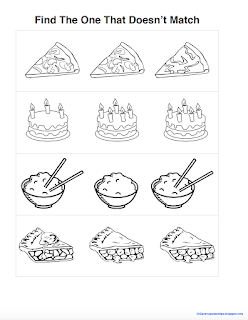
-“Which one doesn’t belong” activities.
-Have the child look at a magazine page and circle all of the letter A’s, t’s, etc.
-Make worksheets that instruct the child to circle the matching letter
w – m n w m z
E – M E W Z
-Have the child practice with hidden picture and hidden-word books such as "Where's Waldo?"
Tuesday, May 3, 2011
Visual Memory
Visual Memory is the ability to look at a shape, object, form, number, or letter and remember it. This is an important skill that is needed with all learning and is affected by attention, concentration, and observation skills. Children with poor visual memory usually have problems copying from the board to the paper.
Visual Memory Activities
-Copying a series of body movements as demonstrated by example.
-Moving to stand on different sheets of construction paper that are various colors, shapes, etc. Hold up a sample of which the child should move to, and then remove from his sight.
-Display objects, pictures, toys, colored blocks, etc. for a few seconds and then remove them all and have the child name them.
-Draw a letter, word, or shape and have the child duplicate it after it has been removed.
-Show a group of objects to the child for 3 to 8 seconds. Cover them and remove one and have the child name the one that was removed.
-“Memory” or “Concentration” Games
-Have the child look at a picture, then remove it and have her describe the details.
Reference: Test of Visual Perceptual Skills
Wednesday, April 27, 2011
Visual-Spatial Relationships
Perceiving Visual-Spatial Relationships is the ability to perceive the position of two or more objects in relation to each other and in relation to your own self. For example, a child walking through a classroom must know where he is positioned in relation to the furniture and his classmates. Children with problems in this area may have challenges with maneuvering through space, with ball skills, and with writing and spacing between words and letters. These students also have difficulty with concepts such as “up”, “down”, “left” and “right”.
Here are some activities to address difficulties with visual-spatial relationships:
-Make an activity sheet of identical shapes, forms, letters, etc. with one of them positioned differently. Have the child point to the one that is oriented in a different direction.
-Do the same as above, but use actual objects. For example, line up for paper clips on the table with one slightly rotated and ask, “which one is in a different position?”
-Climbing through a homemade obstacle course of pillows, blankets, etc.
-Parquetry blocks
, tangrams, and pegboard design sets
(found at Amazon and school supply stores). Have the child reproduce shapes or forms from an example.
-Equilibrio Game
-Equilibrio Game
-Jig saw puzzles
-Have the child draw a person with all parts of the body, or assemble a person out of cut out body parts.
-Drawing maps of home, school, etc. Trace the way from one room to another.
-Gross motor activities of running, hopping, jumping, skipping around obstacles.
-Throwing objects at a target (bean bags, balls)
-Simon Says, Hokey Pokey games
Monday, April 25, 2011
Visual Perceptual Skills
Visual Perception refers the brain’s ability to make sense of what the eyes see. This is not the same as the term visual acuities, which means how clearly a person sees (for example “20/20 vision”). A person can have 20/20 vision and still have problems with visual perceptual processing. Good visual perceptual skills are needed for reading, writing, cutting, drawing, completing math problems, as well as many other skills. A child who has problems with perceptual processing might have difficulties working puzzles, copying block designs, or discriminating shapes, pictures or letters.
Seven of the terms that are traditionally included as
“sub-areas” under the term visual perception are listed below. In upcoming posts, I will define these terms and provide activity suggestions to address weaknesses in these specific perceptual “sub-areas”. It is important to note that visual perceptual deficits cannot be remediated with practice. These activities are designed to help children compensate for visual perceptual deficits and assist them to capitalize on their visual perceptual strengths.
Sub-Areas - (According to the Non-Motor Test of Visual Perceptual Skills, 3rd Edition)
-Visual Discrimination
-Visual Memory
-Visual-Spatial Relationships
-Visual Form Constancy
-Visual Sequential-Memory
-Visual Figure Ground
-Visual Closure
If you suspect that a child has visual perceptual processing problems, you may want to request an evaluation by a professional, such as a psychologist or occupational therapist. There are several assessments available that can determine a child's perceptual strengths and weaknesses such as:
The Non-Motor Test of Visual Perceptual Skills, 4th Edition
Motor Free Visual Perception Test, 4th Edition
Beery Test of Visual Perception (a sub-test of the Beery Test of Visual Motor Integration)
For information about therapeutic Visual Perceptual Activities and Products-
Click HERE!
If you found this post helpful, please "like" my Facebook page! Thanks :)
Subscribe to:
Posts (Atom)


http://drannezachry.com/wp-content/uploads/2016/04/Visual-Closure.pdf