Showing posts with label Sensory Activities. Show all posts

Wednesday, July 15, 2026

Edible Finger Paint Activity!

Finger painting is a wonderful sensory activity, and it is also a great way to work on drawing, pre-writing, and writing skills. It's so simple to make and it's a great activity for a rainy day or a screened free afternoon. 
You will just need some food coloring and vanilla yogurt! Put 2 to 3 drops of food coloring into the yogurt, and stir well! Have fun finger painting. You can even show your child how to mix colors such as blue and yellow to make green. So much fun!!!
 

Saturday, August 30, 2025

Obstacle Course Ideas!

An obstacle course is a great activity to work on improving a child’s body awareness, motor planning, strengthening, sensory processing, and ability to follow instructions. When creating an obstacle course for a child, it can be very motivating to follow a theme that is of interest to the child. For example, possible themes are dinosaurs, jungle animals, or outer space. 

An example course might require the child to hop on one foot to a pile of pillows where the child finds a hidden item. Use an animal walk (i.e. bear walk) to go to another destination to complete a fine motor activity. Lastly, walk on a balance beam to the finish line.  Here are some additional skills that can be addressed with obstacle courses.

·      Following multi-step directions

·      Midline crossing activities

·      Work on core strength

·      Running

·      Climbing

·      Fine motor tasks

·      Balance

Monday, July 22, 2024

Create a Kinetic Sand Sensory Bin!!!

A kinetic sand sensory bin is great for sensory exploration and learning. It is a wonderful way to stimulate multiple senses at once, and children can also learn how to tolerate new and different textures when playing and exploring in the sensory bin.

Supplies Needed:
A medium to large plastic bin
Kinetic sand
Large buttons
Pom-poms
Large marbles
Blocks
LEGO pieces
Plastic animals or insects
Plastic letters, shapes, and/or numbers

Tools such as tongs, large tweezers, a plastic spoon, or a small plastic shovel can be used to dig, stir, scoop, and pull pieces out. or the child can just explore with their hands. If the child resists touching the kinetic sand, start by having them explore using one of the tools listed above.

Sensory bin play is also a great way to work one naming colors, shapes, animals, letters, numbers and concepts such as up, down, inside, beside, soft, and hard.  

So please consider putting together a sensory bin that is age appropriate for your child!

Note: Provide direct supervision for children who might put the sand or objects in their mouth. 

This project was completed by a Master of Occupational Therapy student at The University of Tennessee Health Science Center and posted with permission.
Monday, March 7, 2022

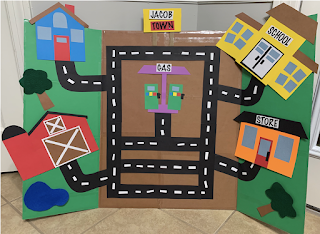
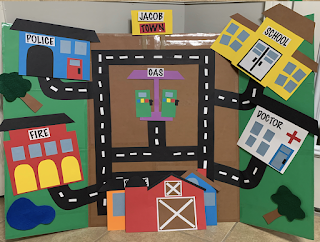
Going to Town: An Activity to Improve Balance!

This is a fun activity to work on sitting and standing balance! The town map is made from a trifold presentation board and is covered in construction paper. The individual buildings are made from card stock and construction paper, and the pond and trees are made from felt. There is Velcro on the back of each building, tree, and pond. This allows a child the creative freedom to arrange and rearrange the board.
 

For a fun treatment activity, have the child sit on a rocker board and decide which pieces to place in different spots on the board. Then have the child “drive” a toy car from one place to the other. Have the child work on following directions by asking him to drive from home to the school, etc. To grade this activity, have the child start by sitting on a rocker board then progress to standing. There is also the option of “driving” the car on the road in the center of the board, then as he becomes more comfortable with the movement of the rocker board, and then “drive” on the road to the outer edges of the board. The board can also be placed various distances from the child. For example, to begin, he could be very close to the board and as he becomes more comfortable with the rocker board and his balance improves, the distance could be increased to change how far he has to reach in order to “drive” from place to place.  

This project was completed by a Master of Occupational Therapy student at The University of Tennessee Health Science Center and posted with permission.

Sunday, August 8, 2021

Sensory Activities to Carry Out at Home!

When a child gets the sensory input that their body needs throughout the day, it helps them stay calm and focus. Typically, I recommend that a child carry out two to three of the sensory activities included in this home program approximately every two hours throughout the day. Please consult with your child's occupational therapist for recommendations that are appropriate for your child's sensory needs.

Sensory Activities 


Photo Credit: StockPhotoFreeDigitalPhotos.net

Friday, March 1, 2019

Sensory Writing Activities

Because many of our sensory systems contribute to the process of writing legibly, when a child struggles with handwriting, it may be helpful to incorporate sensory strategies in with handwriting instruction. I call this “Sensory Writing!”  Here are some fun, sensory-based ways to work on handwriting skills.
Shaving Cream Writing: Put a small amount of shaving cream on a surface.  Remember, a little goes a long way!  Then have the child smooth it out across the surface and practice forming basic shapes, letters, or numbers.  Mistakes are not a problem!  Simply erase them with a swipe of the hand!
 
 Rice Writing: Have the child use a marker to color the surface of a paper plate.  Once it dries, sprinkle a layer of rice on the plate.  Now it’s time to practice writing shapes, letters, and numbers in the rice!
Putty Writing:  Roll play dough or therapy putty to form various letters.  Squeezing, pulling, and pinching are all great for fine motor skills, and making the letters helps with letter formation.
Remember, it's important for children to have plenty of opportunities to move throughout the day.  This will help them pay attention, and it warms up their muscles and joints for writing and other fine motor activities!


Saturday, August 18, 2018

Gravitational Insecurity Activities

Children with gravitational insecurity typically respond to movement activities by overreacting emotionally.  Why?  Their vestibular system is not functioning properly. These kids are extremely afraid of heights, falling, and they resist having their feet leave the ground. For this reason, children with gravitational insecurity children prefer to stay low to the ground.  They are typically lying down or sitting and doing their best to avoid movement.

How can I help my gravitationally insecure child?
  1. It may be helpful to physically guide your child during play activities such as climbing, sliding and swinging. You can swing with your child in your lap, and this might provide just enough security to prevent a fearful response.
  2. Encourage your child to participate in climbing, crawling, and jumping activities that are within his comfort zone.
  3.  Demonstrate movement activities such as this for your child, “watch me to this, or do it just it the way I do this.”
  4. Introduce new movement activities gradually and a little bit at a time.
  5. Encourage water play in the pool that includes movements such as twirling, jumping, and flipping.  The water might make your child feel more secure.
  6. If your child has extreme responses to movement, I recommend pursuing occupational or physical therapy. 
 freedigitalphotos.net by dvrcan


Tuesday, January 12, 2016

Tabletop Sensory Garden


This tabletop garden is full of sensory flowers/items that children will enjoy touching and exploring! As the child feels the different flowers, be sure to have her name the colors and explain how each one feels.  

Supplies:

Brightly colored flower vase
Plastic leis
Plastic straws
Plastic loofah
Styrofoam balls
Q-tips
Plastic scrubbing dish pads
Wire cutters
Squishy caterpillar toy
Foam dish scrubber
Butterfly clip
Twisty tie
Instructions:
1.     Place five plastic leis in the metal flower vase. Push the leis down firmly. Set aside.
2.     Cut q-tips in half using wire cutters. Firmly push cut q-tips into Styrofoam ball until the ball is covered to desired thickness to create a flower, leaving room for a stem at the bottom.  Push a plastic straw into the bottom of the Styrofoam ball to create a stem. Set aside.
3.     Push another plastic straw into the plastic scrubbing dish pads. Set aside.
4.     Wrap the loop at the end of the squishy caterpillar toy several times until it is secured onto another plastic straw to create another flower. Set aside.
5.     Pull the foam top piece out of the foam dish scrubber.  Wrap the foam piece around another straw and secure with a metal twisty tie to create another flower. Set aside.
6.     Cut the string handle off of the loofah.  Push another plastic straw into the middle of the loofah to create another flower. Set aside.
7.     Take all the flowers you have created and push them into the leis in the flower vase, arranging them how you choose.
8.     Clip butterfly clip to the side of the flower vase.
9.     Your sensory garden is ready!

The project above was completed by one of our Master's of Occupational Therapy students at 
The University of Tennessee Health Science Center and posted with permission.


Saturday, August 8, 2015

Sensory Lap Pads!

Check out these "sensory lap pads" made by members of the Memphis Area Modern Quilt Guild!  This is such a creative idea! Members of the guild sewed these as a service project.
The wonderful thing about them is that they are portable! Just fold and snap and you can take it anywhere.
This will be my next sewing project!!!


Dear Readers, If you have found my blog to be helpful, please click here and "like" my facebook page... 
Thanks :) 


Wednesday, April 1, 2015

OCCUPATIONAL THERAPY: It's the Little Things that Make Life BIG!

It’s April, and it’s time to celebrate Occupational Therapy Month!  Pediatric OT Tips is celebrating OT Month by having a blog series called OCCUPATIONAL THERAPY: It's the Little Things that Make Life BIG!

This month's posts will feature special stories of how occupational therapy made a positive difference in someone’s life! The stories will come from therapists as well as patients. So let’s get started!
Photo Credit: Naypong @ freedigitalphotos.net
Jason was a nonverbal 7-year old boy with a diagnosis of Autism Spectrum Disorder. He also had sensory processing challenges! He didn’t know where his body was in space and craved constant deep pressure input. When I evaluated him, I asked his mother about her goals for Jason. She shared that she would like Jason to be able to brush his teeth, put on his shirt in the morning, and improve his attention to task. When I asked her what she thought Jason wanted to be able to do, she said, “Oh, that’s easy, he wants to learn how to ride his bike!”

Every afternoon, weather permitting, Jason’s little brother would ride his bicycle up and down their long driveway. Without fail, Jason would attempt to join him. Jason could get on the bike independently, but all attempts to teach him to ride the bike (using training wheels) had failed.

After several OT sessions, it became clear that Jason’s sensory and language challenges were part of the problem.  Jason’s mother would tell him to “push the pedals,” but Jason would just stare at her confused. So, during Jason’s sensory play, we started working on the concept of push. With Jason positioned on his back, feet in the air, I would put my hand on Jason’s foot and say “push!”  No response.

One day while browsing at the dollar store (my favorite therapy shop!), I spotted several squeaky dog toys.  I had an idea!

During Jason’s next session, I held the toy against his foot and told him to “make the toy squeak.”  As soon as he pushed against the toy to make it squeak, I said, “Yes, you are pushing!”  By the end of the session, he was pushing his foot against my hand on request.

The next session I brought my duct tape (another wonderful OT tool!). With Jason’s mother’s permission, I taped the squeaky toys onto the bike pedals. The rest is history! The squeaky toys helped Jason grasp the concept of “push,” and they are no longer needed. Now Jason loves to ride bikes with his brother after school! No more watching on the sidelines!
To read another "little things" post, click HERE!

Dear Readers, If you have found my blog to be helpful, please follow my blog (on the right of this page) and click here and "like" my facebook page... 
Thanks :) 

Sunday, December 7, 2014

Make Your Own Sensory Tunnel! Therapy on a Shoestring Budget


This was a project completed by one of our Master's of Occupational Therapy students at The University of Tennessee Health Science Center and posted with permission.


Do you know a child with sensory issues that you believe would benefit from a sensory tunnel? They are wonderful for obstacle courses and a variety of other therapeutic activities. Unfortunately, sensory tunnels can be expensive, costing over $100.00 at many therapy supply stores.  But on the positive side, there are inexpensive options.

The above sensory tunnel was made by a MOT student as a project for a pediatric class at UTHSC, and guess what? It costs less than $20.00! All that you need are two inexpensive "pop-up" laundry hampers and a needle and sturdy thread or some Duct tape.  Stitch or tape the hampers together, and you're good to go! Be sure to use the tunnel during a purposeful activity. For example, have the child crawl through the tunnel to retrieve a desired item at the opposite end.  Have fun!!!!

Dear Readers, If you have found my blog to be helpful, please "like" my Facebook page and follow my blog...Thanks :) 

Saturday, November 9, 2013

Home Activities for Children with Special Needs: Keeping it Fun!

I was recently asked to write a guest post for one of my favorite blogs: Love That Max! In the post, I shared some fun home exercise activities for children with special needs. Click HERE to read the post!

Wednesday, June 19, 2013

Sensory Diet Activities

When a proper sensory diet is put in place, it helps a child with sensory processing issues function better on a daily basis. Typically, I recommend that a child carry out two to three of the sensory activities below approximately every two hours throughout the day. Please consult with your child's occupational therapist for recommendations that are appropriate for your child's sensory needs.
-      Lying under a weighted blanket
-      Wearing a weighted vest (as recommended by an occupational therapist)
-      Jumping on a trampoline
-      Jumping on overstuffed pillows
-   Climbing through homemade obstacle courses
-      Carrying heavy objects- i.e. Helping put away heavy groceries
-      Wheelbarrow walking
-      Tug-of-war games
-      Popping bubble wrap
-      Rolling self up in a blanket like a burrito, then rolling back out
-      Sit-ups
-      Push-ups on the floor, or against a wall while standing
-      Spinning on a sit-n-spin
-      Stomping feet/clapping hands (have the child follow your pattern)
-      Tossing/rolling a weighted ball back and forth
-   Sitting on a therapy ball and bouncing
-   Tummy down on a therapy ball rocking forward and backward 
     
Dear Readers, If you have found my blog to be helpful, please "like" my Facebook page and follow my blog...I'm trying to get my book published and this would be a great help! Thanks :) 


Monday, November 19, 2012

Teaching Colors Using Multi-Sensory Instruction


If you are working with a student who is having difficulty learning his colors, implementing a multi-sensory approach might be effective.

Pair each color with a song. The following songs are nice because each color song has a different tune:

Black Color Song
Red Color Song
Yellow Color Song
Blue Color Song
Green Color Song
Purple Color Song
Orange Color Song

Pair each color with a scent. (The child can even smell the appropriate scent while she sings each color song). Scented markers are great and are available at Amazon.

Black- Licorice                Red-Cherry             Blue-Blueberry
Yellow-Lemon                Green-Mint              Orange-Orange
Brown-Cinnamon         Purple-Grape          Pink-Melon
Turquoise-Mango      Dark Green-Apple    Magenta-Raspberry


Photo Credit Salvatore Vuono @ freedigitalphotos.net

Connect the color with something meaningful. "Goldfish snacks are orange. The ball in the therapy room is blue." Food is especially good because it pulls in the sense of taste...."lemons are yellow, orange juice is orange."

Here's an example of an approach I used in therapy:

The student sits on the red therapy ball and tosses several red balls into a red bucket as I sing or play the "red song". Then we move to a table and the child colors a picture of a red firetruck  using the red scented marker while the "red song" is playing in the background.


Eventually, the pairing should not be necessary, but initially the goal is to help the student associate the smells, songs, etc. with the particular colors. At some point, when the child sees the color green, the song & smell for green should come to mind and this will help them remember "that's the color green."